.png?width=18&height=18&name=Vector%20(5).png)


Let’s be honest. Sometimes sales meetings are a waste of time.
They start late. They drift. Someone pulls up a dashboard. Someone else talks about a deal that’s been “90% close” for three weeks. There’s no clear objective. No clear next steps. And by the end, everyone leaves thinking, “That could’ve been an email.”
The problem isn’t your team.
It’s the lack of a real sales meeting agenda.
Because here’s the truth: a sales meeting without structure doesn’t drive revenue, it drains it.
In this guide, we’ll break down:
- A practical sales meeting agenda template you can use immediately
- A real-world sales meeting agenda example
- How to structure a high-impact weekly sales meeting
- Common mistakes that quietly kill productivity
- And how AI tools like Meeting AI can transform the way your team prepares, runs, and follows up on meetings
What Is a Sales Meeting Agenda?
A sales meeting agenda is a structured plan that outlines what will be discussed, in what order, and with what outcome during a sales team meeting.
It’s not just a list of topics.
It’s a revenue roadmap for the next 30–60 minutes.
A strong sales meeting agenda defines:
- The objective of the meeting
- The key metrics or deals to review
- Who owns each discussion point
- The time allocated per topic
- Clear next steps and accountability
Without structure, meetings drift into updates, opinions, and storytelling. With structure, they drive pipeline movement, forecasting accuracy, and rep accountability.
For revenue teams, that difference matters.
Different Types of Sales Meetings (And How to Structure Them)
Here’s where most teams get it wrong. They use the same agenda for every meeting.
And then they wonder why nothing changes.
Let’s break down the five most important types of sales meetings and how to structure each one so it actually drives revenue.
1. Pipeline Review Meeting Agenda
Goal: Move deals forward.
Frequency: Weekly
This meeting isn’t about reading the CRM out loud.
It’s about pressure-testing opportunities and accelerating revenue.
Structure it like this:
- Quick snapshot of total pipeline vs target
- Focus only on high-impact deals
- Identify stalled opportunities (no activity, no movement)
- Surface risks, competitors, and blockers
- Clarify the next action for every key deal
- Assign ownership and deadline
If a deal doesn’t have a next step, it’s not progressing. Period.
Pipeline meetings should feel sharp. Focused. Forward-moving.
2. Forecast Meeting Agenda
Goal: Improve revenue predictability.
Frequency: Weekly (leadership), Monthly (team)
This is not a storytelling session.
This is about math.
Structure it like this:
- Review commit, best case, and pipeline coverage
- Compare forecast vs quota
- Challenge close probabilities
- Identify slippage risks
- Lock in final numbers
The rule here is simple: optimism doesn’t count, data does.
When forecast meetings are structured properly, surprises disappear.
3. Sales Coaching Meeting Agenda
Goal: Make reps better.
Frequency: Weekly or biweekly
Too many “coaching” meetings turn into performance reviews.
That’s not coaching.
Coaching is about sharpening skills before deals are lost, not after.
Structure it like this:
- Review recent wins and losses
- Deep-dive into one active opportunity
- Analyze one call or objection
- Identify one skill to improve
- Role-play or refine messaging
- Set one improvement commitment
One focused improvement per session beats ten vague suggestions.
4. 1:1 Sales Rep Meeting Agenda
Goal: Drive accountability and growth.
Frequency: Weekly
This is where leadership happens.
Not in the big meeting. Here.
Structure it like this:
- Rep shares updates first
- Review KPIs and pipeline health
- Discuss blockers
- Offer direct feedback
- Align on weekly commitments
- Confirm support needed
If your rep leaves unclear about expectations, the meeting failed.
Clarity builds momentum.
5. Quarterly Sales Strategy Meeting Agenda
Goal: Adjust direction and drive growth.
Frequency: Quarterly
This isn’t a longer pipeline meeting.
It’s a reset.
Structure it like this:
- Review quarterly revenue performance
- Analyze win/loss trends
- Evaluate market shifts
- Identify process bottlenecks
- Refine ICP and targeting
- Set next quarter objectives
- Align on execution strategy
Quarterly meetings should feel strategic, not tactical.
Zoom out. Then commit.
How AI Improves Your Sales Meeting Agenda
Manual agendas are often reactive. They rely on memory, scattered notes, and last-minute CRM checks.
AI-powered agendas are proactive, contextual, and data-driven.
Here’s how tools like Cirrus Insight's Meeting AI transform the way revenue teams prepare and execute sales meetings.
AI-Generated Pre-Meeting Summaries
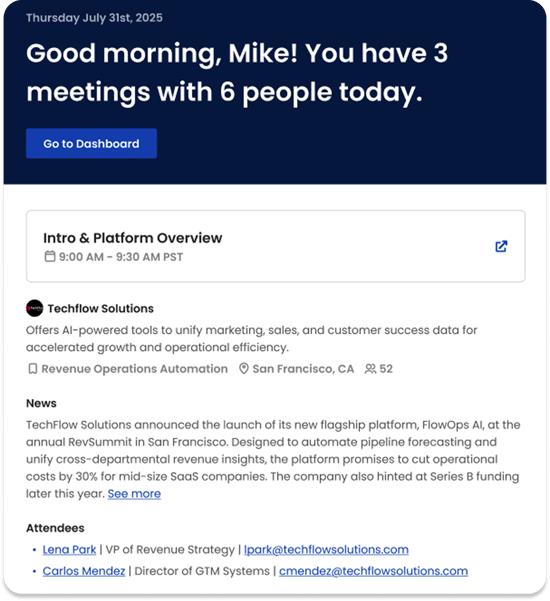
Instead of manually reviewing email threads, CRM updates, and previous call notes, Meeting AI automatically compiles a concise pre-meeting summary.
Reps instantly see:
- Prior commitments
- Open objections
- Stakeholders involved
- Recent activity
- Deal risks
Preparation becomes structured and consistent, without extra effort.
Automatic Agenda Suggestions
Based on deal stage, pipeline data, and engagement signals, AI can recommend agenda topics tailored to that specific opportunity.
For example:
- Address pricing concerns
- Confirm implementation timeline
- Clarify decision process
- Re-engage silent stakeholders
This turns generic meetings into focused revenue conversations.
CRM-Based Context Pulling
Meeting AI connects directly to Salesforce to pull live deal data into the agenda:
- Opportunity stage
- Close probability
- Deal size
- Recent activity
- Account history
Every meeting starts with accurate, real-time context, not assumptions.
Real-Time Note-Taking
During the meeting, AI captures structured notes automatically.
Reps stay focused on the conversation while the system records:
- Key talking points
- Objections
- Competitive mentions
- Buying signals
Notes are complete, searchable, and synced to Salesforce.

Run Smarter Sales Meetings with Cirrus Insight
A strong sales meeting agenda creates structure.
But structure alone isn’t enough anymore.
Modern revenue teams need visibility, automation, and real-time intelligence behind every conversation. They need agendas built from live CRM data. They need notes captured automatically. They need follow-ups executed without delay.
That’s where Cirrus Insight changes things.
With Meeting AI, your team can:
- Automatically generate pre-meeting summaries from Salesforce
- Pull real-time deal context into every agenda
- Capture notes and action items without manual entry
- Sync updates directly to Salesforce
- Automate follow-up emails and tasks
- Maintain full visibility across pipeline conversations
Instead of scrambling before meetings and cleaning up CRM data afterward, your reps stay focused on what actually drives revenue: meaningful conversations and next steps.
Sales leaders gain clearer forecasting. Managers get better coaching insights. Reps spend more time selling, not documenting.
If your goal is to run more productive, data-driven, revenue-focused meetings, Cirrus Insight gives you the infrastructure to do it consistently.
Ready to transform your sales meeting agenda from reactive to revenue-driving?
Book a demo with Cirrus Insight and see how Meeting AI helps your team prepare smarter, execute better, and close faster.
Sales Meeting Agenda FAQs
What is a sales meeting agenda?
A sales meeting agenda is a structured outline that defines the topics, objectives, and time allocation for a sales meeting. It ensures conversations stay focused on pipeline movement, forecasting accuracy, coaching, or strategy rather than drifting into unproductive updates.
Why is a sales meeting agenda important?
A well-defined sales meeting agenda improves efficiency, accountability, and revenue impact. It helps sales teams prioritize high-value opportunities, clarify next steps, and eliminate wasted time during pipeline and forecast discussions.
What should be included in a weekly sales meeting agenda?
A weekly sales meeting agenda should include pipeline review, key deal updates, stalled opportunities, risk analysis, and defined next steps. The goal is to accelerate deals and improve forecast visibility while maintaining team alignment.
What is the difference between a pipeline review and a forecast meeting agenda?
A pipeline review meeting agenda focuses on moving active deals forward and removing blockers. A forecast meeting agenda focuses on revenue predictability, close probability validation, and quota alignment.
Is there a sales meeting agenda template I can use?
Yes, a sales meeting agenda template typically includes objectives, deal review sections, risk assessment, action items, and follow-up responsibilities. Using a consistent template improves meeting discipline and ensures measurable outcomes.
What is an example of a sales meeting agenda?
A sales meeting agenda example may include reviewing top opportunities, identifying stalled deals, addressing objections, confirming next steps, and assigning ownership. The structure varies depending on whether the meeting is weekly, quarterly, or coaching-focused.
How does AI improve a sales meeting agenda?
AI improves a sales meeting agenda by generating pre-meeting summaries, pulling CRM context automatically, capturing real-time notes, and extracting action items. This shifts meetings from reactive discussions to proactive, data-driven conversations.
How does Cirrus Insight improve sales meeting preparation?
Cirrus Insight improves sales meeting preparation with Meeting AI, which automatically compiles Salesforce data, creates structured summaries, tracks notes in real time, and logs follow-ups into your CRM. This reduces manual prep time and improves meeting consistency.
Can AI automatically create a sales meeting agenda?
Yes, AI-powered tools like Cirrus Insight Meeting AI can generate agenda suggestions based on deal stage, pipeline activity, and CRM data. This ensures every sales meeting is aligned with revenue priorities and next-step execution.