.png?width=18&height=18&name=Vector%20(5).png)
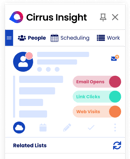
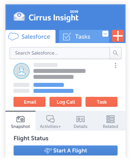

Forecasts miss. Deals stall. Reps say, “It’s still looking good,” right up until it isn’t.
If that sounds familiar, you’re not alone. Studies consistently show that B2B sales forecasts are often off by double digits, not because teams aren’t working hard, but because they’re missing signals hidden inside emails, calls, and meetings.
The CRM shows stages and close dates. What it doesn’t always show is deal risk, buyer disengagement, or the subtle patterns that separate closed-won from closed-lost.
That’s where deal intelligence software enters the picture.
Instead of relying on manual updates and gut instinct, deal intelligence tools automatically capture sales activity, analyze buyer engagement, surface risk indicators, and help revenue leaders understand what’s actually happening inside active opportunities.
In this guide, we’ll break down what deal intelligence software is, how it works, and which platforms are leading the space in 2026, so you can choose a solution that improves visibility, forecasting accuracy, and deal execution.
What Is Deal Intelligence Software?
Deal intelligence software is a category of sales technology that automatically captures, analyzes, and interprets activity within active sales opportunities to help teams close more deals and improve forecast accuracy.
In simple terms, it answers a critical question:
What’s really happening inside this deal and are we going to win it?
Unlike a traditional CRM, which relies heavily on manual updates and stage tracking, deal intelligence software pulls data from real sales interactions, emails, calls, meetings, buyer engagement, and CRM activity and turns that raw activity into actionable insight.
What Is Sales Deal Intelligence Software?
When people search “what is sales deal intelligence software,” they’re typically referring to tools built specifically for revenue teams.
Sales-focused deal intelligence platforms help teams:
- Detect deal risk early (before it shows up in the forecast)
- Identify disengaged stakeholders
- Surface buyer signals across conversations
- Analyze rep activity patterns
- Improve pipeline inspection with data instead of gut instinct
Instead of asking reps, “How’s the deal looking?” managers can see objective signals that show momentum, stagnation, or risk.
How Deal Intelligence Software Differs From a CRM
A CRM stores information.
Deal intelligence interprets it.
Here’s the difference:
- CRM: Tracks deal stage, close date, and manually entered notes
- Deal intelligence software: Analyzes real activity to determine deal health, engagement trends, and risk indicators
For example:
- A deal might sit in “Proposal Sent” for 14 days.
- Deal intelligence software might flag that no executive stakeholder has responded and buyer engagement has dropped 60%
That’s the difference between record-keeping and predictive insight.
10 Best Deal Intelligence Software Tools in 2026
Choosing the right deal intelligence software isn’t about dashboards alone, it’s about how effectively a platform captures real buyer activity, surfaces risk signals, and keeps your CRM aligned with reality. Below are the leading tools revenue teams are evaluating in 2026.
1. Cirrus Insight
Best for: Salesforce-driven revenue teams that want operational deal intelligence without heavy enterprise overhead.
Core strength: Automatic CRM sync + AI meeting intelligence + buyer signal tracking built directly into Salesforce workflows.
AI capabilities:
- AI meeting summaries (Conversational Insights)
- Post-call action item extraction
- Buyer engagement signals
- Live coaching nudges
- Activity-based deal momentum visibility
Data sources analyzed: Emails, meetings, call recordings, engagement activity, CRM updates.
CRM integration depth: Deep, native Salesforce integration (real-time sync of emails, meetings, tasks, and activity).
Pricing tier: Flex model, so you only pay for the features you actually use.
Pros:
- Reduces manual CRM updates
- Improves forecast accuracy through real activity capture
- Fast implementation compared to enterprise revenue intelligence suites
- Built around execution, not just analytics
Limitations:
- Best suited for Salesforce users
- Not positioned as a standalone forecasting engine

2. Gong
Best for: Enterprise sales organizations seeking advanced conversation intelligence and deal analytics.
Core strength: AI-driven call analysis and deal risk detection at scale.
AI capabilities:
- Deal risk scoring
- Talk-to-listen ratio tracking
- Keyword and objection analysis
- Win/loss pattern identification
Data sources analyzed: Calls, emails, CRM data, meeting transcripts.
CRM integration depth: Strong integrations with Salesforce and HubSpot.
Pricing tier: Typically starts around $1,200–$1,500 per user per year (enterprise contracts required).
Pros:
- Highly advanced analytics
- Strong enterprise credibility
- Detailed coaching dashboards
Limitations:
- Higher cost
- Longer implementation cycles
3. Clari
Best for: Revenue teams focused primarily on forecast accuracy and pipeline visibility.
Core strength: Forecast modeling and pipeline inspection tools.
AI capabilities:
- Predictive forecasting
- Pipeline risk scoring
- Commit scenario modeling
Data sources analyzed: CRM data, activity tracking, revenue metrics.
CRM integration depth: Deep Salesforce integration; acts as overlay.
Pricing tier: Enterprise pricing; typically $1,000+ per user per year.
Pros:
- Forecast-centric insights
- Strong executive reporting
- Multi-level revenue visibility
Limitations:
- Less granular conversational intelligence
- Complex implementation for smaller teams
4. Clari Copilot
Best for: Teams wanting conversation intelligence integrated into Clari forecasting.
Core strength: Conversation analysis aligned with forecast outcomes.
AI capabilities:
- Call transcription
- Deal health alerts
- Conversation-based risk signals
Data sources analyzed: Calls, CRM data, meeting transcripts
CRM integration depth: Primarily Salesforce
Pricing tier: Enterprise-level pricing bundled within Clari ecosystem
Pros:
- Connects conversation data to forecast
- Good risk detection features
Limitations:
- Requires Clari ecosystem
- Premium pricing
5. People.ai
Best for: Enterprises needing automated activity capture and revenue inspection.
Core strength: AI-based activity tracking and deal inspection dashboards.
AI capabilities:
- Automated CRM activity capture
- Relationship mapping
- Pipeline gap detection
Data sources analyzed: Email, calendar, CRM, messaging platforms
CRM integration depth: Strong Salesforce integration
Pricing tier: Enterprise pricing (custom quotes)
Pros:
- Strong activity automation
- Good for RevOps
Limitations:
- Complex onboarding
- Less conversation intelligence depth
6. BoostUp
Best for: Mid-market and enterprise teams focused on predictive forecasting.
Core strength: Forecast modeling + deal risk visibility.
AI capabilities:
- Predictive deal scoring
- Scenario planning
- Forecast variance analysis
Data sources analyzed: CRM data, sales activity metrics
CRM integration depth: Salesforce-centric
Pricing tier: Mid-to-enterprise range pricing.
Pros:
- Strong predictive models
- Forecast-driven dashboards
Limitations:
- Less focus on execution workflow
7. Outreach Kaia
Best for: Teams already using Outreach engagement platform.
Core strength: Real-time call intelligence within sales engagement workflows.
AI capabilities:
- Real-time conversation coaching
- Keyword tracking
- Objection detection
Data sources analyzed:Calls, engagement activity, CRM sync
CRM integration depth:Integrates with Salesforce and other CRMs
Pricing tier: Enterprise add-on pricing
Pros:
- Embedded within engagement flow
- Strong live coaching
Limitations:
- Best used within Outreach ecosystem
8. Salesloft Revenue Intelligence
Best for: Salesloft customers seeking deeper pipeline insight.
Core strength: Engagement + deal analytics overlay.
AI capabilities:
- Conversation tracking
- Engagement-based risk alerts
Data sources analyzed: Salesloft engagement activity + CRM
CRM integration depth: Salesforce integration supported
Pricing tier: Enterprise-level pricing
Pros:
- Unified engagement + analytics
- Good visibility into rep activity
Limitations:
- Less standalone intelligence depth
9. HubSpot Revenue Intelligence
Best for: HubSpot-native teams.
Core strength: Built-in conversation intelligence for Sales Hub users
AI capabilities:
- Call transcription
- Conversation insights
- Pipeline tracking
Data sources analyzed: HubSpot CRM, calls, emails
CRM integration depth: Native to HubSpot only
Pricing tier: Available in higher-tier Sales Hub plans (Professional/Enterprise)
Pros:
- Seamless within HubSpot
- No additional tool required
Limitations:
- Limited outside HubSpot ecosystem
10. Avoma
Best for: Teams needing meeting intelligence with light revenue analytics.
Core strength: AI meeting summaries and conversation tagging
AI capabilities:
- Automated note-taking
- Action item extraction
- Conversation trend analysis
Data sources analyzed: Meeting recordings, transcripts.
CRM integration depth: Integrates with Salesforce and HubSpot.
Pricing tier: Starts around $19–$39 per user/month depending on features.
Pros:
- Affordable entry
- Strong meeting automation
Limitations:
- Less advanced forecasting features
Deal Intelligence Software: Strategic Comparison (2026)
|
Tool |
Primary intelligence layer |
Revenue impact focus |
Org complexity fit |
|
Cirrus Insight |
Execution-layer intelligence |
Improves pipeline accuracy through real-time activity capture |
SMB > Mid-market sales teams & Salesforce Enterprise orgs |
|
Gong |
Conversation intelligence |
Identifies deal risk through call pattern analysis |
Enterprise sales orgs |
|
Clari |
Forecast intelligence |
Enhances commit accuracy & executive visibility |
Enterprise revenue teams |
|
Clari Copilot |
Conversation + forecast alignment |
Links call insights directly to forecast outcomes |
Clari ecosystem users |
|
People.ai |
Activity intelligence |
Ensures full sales activity coverage for inspection |
Enterprise RevOps-led orgs |
|
BoostUp |
Predictive pipeline modeling |
Forecast variance & scenario analysis |
Mid-market > Enterprise |
|
Outreach Kaia |
Live coaching intelligence |
Improves rep performance during calls |
Outbound-heavy teams |
|
Salesloft Revenue Intelligence |
Engagement intelligence |
Connects rep activity to deal progression |
Salesloft customers |
|
HubSpot Revenue Intelligence |
CRM-native conversation insights |
Improves pipeline visibility inside HubSpot |
SMB > Mid-market HubSpot users |
|
Avoma |
Meeting intelligence |
Converts meeting data into deal-level insights |
SMB |
How to Choose the Best Deal Intelligence Software (Without Overbuying)
Not all deal intelligence software is built for the same problem. Before booking a demo, get clear on what you’re actually trying to fix.
Are You Trying to Fix Forecast Accuracy or Rep Execution?
If your biggest issue is inaccurate forecasts and pipeline visibility at the leadership level, you’ll likely lean toward enterprise forecasting platforms.
If the real problem is stalled deals, inconsistent follow-ups, or missing buyer signals, you may need operational deal intelligence that improves execution at the rep level.
Know which lever matters more.
Does Your CRM Have a Data Quality Problem?
If reps aren’t logging emails, meetings, or next steps consistently, your forecast will always be unreliable.
In that case, prioritize platforms that:
- Automatically capture activity
- Sync in real time with Salesforce or HubSpot
- Reduce manual data entry
If your CRM data is already clean, you may focus more on predictive analytics instead.
Do You Need Enterprise Analytics or Operational Automation?
Some tools are built for board-level reporting and complex scenario modeling.
Others focus on:
- Automatic CRM updates
- Buyer engagement signals
- Deal health alerts
- Post-meeting action items
If you don’t need heavy enterprise analytics, an operational intelligence layer may provide faster time-to-value.
How Complex Is Your Sales Motion?
- Short SMB cycles? You need lightweight insight.
- Multi-threaded enterprise deals? You need stakeholder tracking and risk scoring.
- SDR-heavy outbound? You’ll want activity capture and buyer signal visibility.
Match the tool to your deal complexity.
What’s Your Budget Range?
Deal intelligence software pricing varies significantly:
- Enterprise platforms: typically $1,000–$1,500 per user per year
- Mid-market tools: roughly $50–$150 per user per month
- Salesforce-native add-ons: often lower entry pricing with faster implementation
Most vendors don’t publish full pricing publicly. Instead, they encourage a deal intelligence software demo request to provide tailored quotes based on team size and feature requirements.
Understanding your budget range upfront prevents overbuying.
Why Deal Intelligence Software Is Replacing Manual Deal Reviews
For years, pipeline reviews relied on rep updates and manager intuition.
The problem? Manual inspection is subjective.
Reps may unintentionally overestimate deal health. Managers rely on stage progression instead of real engagement data. Forecast changes are often reactive, not predictive.
Traditional pipeline reviews rely on lagging indicators:
- Stage duration
- Close date adjustments
- Verbal deal confidence
Deal intelligence software shifts teams toward leading indicators:
- Buyer response velocity
- Stakeholder engagement depth
- Meeting frequency changes
- Sentiment shifts
- Activity gaps
Instead of asking, “How’s the deal looking?”
Leaders can see objective signals that show whether momentum is increasing or quietly disappearing.
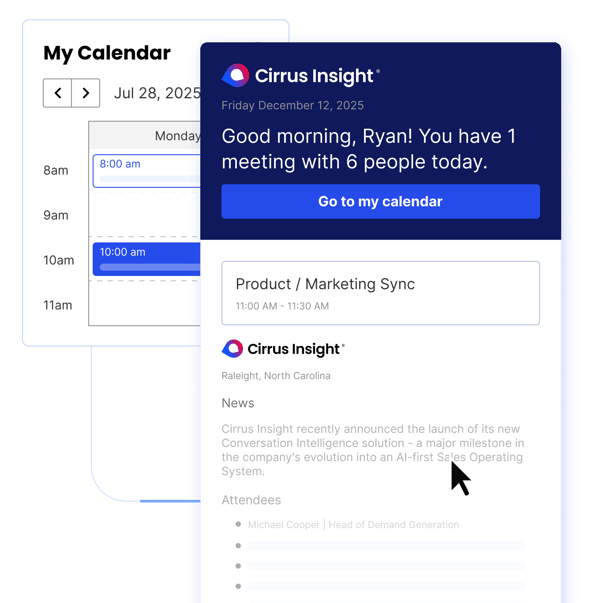
Cirrus Insight: Deal Intelligence That Lives Inside Your CRM
Deal intelligence only works if it reflects reality. And reality lives in your emails, meetings, and buyer conversations, not just in CRM stage fields.
Cirrus Insight helps you move it.
Instead of layering another complex analytics dashboard on top of your tech stack, Cirrus turns everyday sales activity into actionable deal intelligence directly inside Salesforce.
Instead of replacing your CRM, Cirrus strengthens it by automating the operational layer of deal management:
- Automatic email & meeting sync keeps Salesforce 100% up to date
- AI-powered meeting summaries generate action items instantly
- Conversational Insights surface deal signals inside your pipeline
- Buyer engagement tracking highlights momentum shifts
- Smart Scheduler accelerates deal progression
- Sales cadences ensure structured follow-up
- Live coaching nudges guide reps during active deals
The result?
Deals don’t stall because someone forgot to log a call.
Forecasts don’t drift because CRM activity is incomplete.
Managers don’t rely on rep optimism to assess deal health.
For Salesforce-driven revenue teams, Cirrus isn’t just another tool in the stack. It’s the automation engine that turns deal tracking into deal acceleration.
Deal Intelligence Software FAQs
What is deal intelligence software?
Deal intelligence software is a category of sales technology that captures and analyzes activity within active opportunities to identify deal risk, buyer engagement trends, and execution gaps. Unlike traditional CRM systems, it surfaces real-time signals from emails, calls, and meetings to improve forecast accuracy and close rates.
What is sales deal intelligence software?
Sales deal intelligence software focuses specifically on helping revenue teams win more opportunities. It tracks buyer signals, analyzes rep activity, flags stalled deals, and provides actionable insights that help managers coach more effectively and forecast more confidently.
How does deal intelligence software improve forecasting?
Deal intelligence software improves forecasting by using leading indicators, such as buyer engagement levels, response velocity, meeting frequency, and stakeholder involvement, instead of relying solely on stage progression and rep updates. This allows leaders to detect risk earlier and adjust projections proactively.
Is deal intelligence software different from CRM?
Yes. A CRM stores deal data and relies heavily on manual updates. Deal intelligence software interprets sales activity and buyer behavior to assess deal health automatically. Many platforms integrate directly with CRMs like Salesforce to enhance data accuracy and pipeline visibility.
What is the best deal intelligence software?
The best deal intelligence software depends on your goals. Enterprise teams focused on advanced forecasting may prefer predictive revenue platforms, while Salesforce-driven teams seeking automated activity capture and buyer signal visibility may benefit from CRM-native solutions like Cirrus Insight.
How much does deal intelligence software cost?
Pricing varies widely:
- Enterprise platforms often range from $1,000–$1,500 per user per year
- Mid-market tools typically range from $50–$150 per user per month
- Salesforce-native add-ons may offer lower entry pricing
Most vendors provide custom quotes via a deal intelligence software demo request rather than publishing full pricing publicly.
Can deal intelligence software integrate with Salesforce?
Yes. Many leading platforms integrate with Salesforce to sync deal activity, engagement data, and AI-generated insights directly into opportunity records. CRM-native solutions provide the deepest real-time integration and reduce manual data entry.
How do I request a deal intelligence software demo?
Most vendors offer demo requests directly through their website. During the demo, expect a walkthrough of risk scoring, buyer signal tracking, CRM integration depth, and forecasting capabilities tailored to your team size and sales motion.