.png?width=18&height=18&name=Vector%20(5).png)
Some comparisons are straightforward.
This one isn’t.
Because Gong vs Salesforce isn’t just a tool-versus-tool debate, it’s a category clash. One platform analyzes sales conversations and surfaces coaching insights. The other powers your entire revenue engine, storing pipeline data, forecasts, workflows, and customer history.
So when revenue leaders search “Gong vs Salesforce”, what they’re really asking is:
- Do I need conversation intelligence?
- Do I need a CRM?
- Or do I need both?
- And which one actually improves forecasting and close rates?
The confusion makes sense. Both platforms talk about AI. Both talk about revenue visibility. Both claim to improve forecasting accuracy. But they solve very different problems.
In this guide, we’ll break down:
- What Gong actually does (and doesn’t do)
- What Salesforce brings to the table
- Where they overlap
- Where they complement each other
- And how modern revenue teams are bridging the gap between CRM data and real sales conversations
Let’s start by defining what each platform is really built for.
What Is Gong?
Gong is a conversation intelligence platform built to analyze sales calls, emails, and meetings. It records conversations, transcribes them, and uses AI to surface insights about rep performance, deal risk, and buyer behavior.
In simple terms, Gong doesn’t manage your pipeline, it analyzes what’s happening inside your deals.
Here’s what Gong is best known for:
- Recording and transcribing sales calls
- AI-generated summaries and action items
- Coaching dashboards (talk ratios, objection tracking, keyword analysis)
- Deal risk signals based on conversation patterns
- Revenue intelligence reporting layered on top of CRM data
But here’s the important distinction:
Gong is not a CRM.
It relies on integrations with platforms like Salesforce to pull in opportunity data. Without a connected CRM, Gong doesn’t have structured pipeline data to analyze.
So while Gong excels at understanding what was said in a sales conversation, it depends on another system to understand where the deal actually stands.
What Is Salesforce?
Salesforce is a customer relationship management (CRM) platform and for many organizations, it’s the backbone of their revenue operations.
It’s the system where:
- Accounts and contacts are stored
- Opportunities are tracked
- Forecasts are generated
- Tasks and workflows are automated
- Sales performance is reported
If Gong analyzes conversations, Salesforce manages the entire revenue lifecycle.
Key Salesforce capabilities include:
- Pipeline and opportunity management
- Forecasting and quota tracking
- Workflow automation (Flows, approvals, task triggers)
- Reporting and dashboards
- AppExchange ecosystem with thousands of integrations
Unlike Gong, Salesforce is the system of record. It owns the official version of your pipeline data.
However, Salesforce does not natively analyze call recordings or generate deep conversation intelligence insights without add-ons or integrations.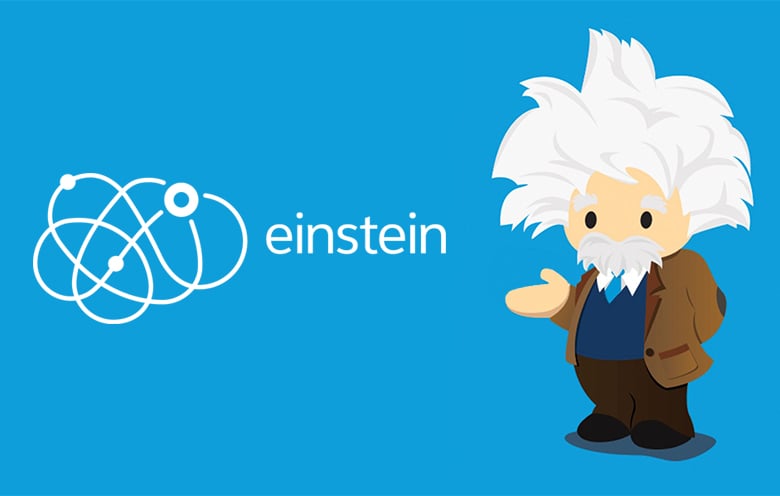
Gong vs Salesforce: Core Difference Explained
Here’s the simplest way to think about it:
- Gong analyzes conversations.
- Salesforce manages structured revenue data.
They operate at different layers of the revenue stack.
|
Category |
Gong |
Salesforce |
|
Primary Role |
Conversation intelligence |
CRM system of record |
|
Focus |
What was said in deals |
Where deals stand |
|
AI Strength |
Call analysis & coaching |
Workflow & predictive CRM AI |
|
Data Ownership |
Pulls from CRM |
Owns opportunity data |
So the question isn’t really “Which is better?”
It’s “What problem are you trying to solve?”
- If you need better visibility into rep conversations and coaching opportunities, Gong shines.
- If you need structured pipeline management and forecasting infrastructure, Salesforce is non-negotiable.
Gong vs. Salesforce Cloud Comparison
At first glance, both platforms promise “revenue visibility.” But they approach that goal from completely different angles.
Let’s break it down where it matters most.
Sales Visibility & Forecasting
Gong enhances forecasting by analyzing conversation signals. It flags deal risks based on language patterns, competitor mentions, or missing next steps in calls.
Salesforce, on the other hand, forecasts based on pipeline data. It looks at opportunity stage, deal size, historical close rates, and rep inputs.
The difference?
- Gong forecasts based on behavior inside the deal
- Salesforce forecasts based on structured pipeline data
But here’s the catch: Gong’s forecasting accuracy depends heavily on how clean your CRM data is. If Salesforce data is outdated, incomplete, or manually entered days later, both systems suffer.
CRM & Data Ownership
Salesforce is the source of truth. It owns:
- Accounts
- Contacts
- Opportunities
- Forecast categories
- Revenue reporting
Gong integrates with Salesforce and pulls opportunity data into its dashboards. It does not replace CRM infrastructure, it enhances it.
So if your CRM activity logging is inconsistent or manual, Gong insights may not reflect the full picture.
AI & Automation Capabilities
Both platforms talk about AI, but the focus is different.
Gong AI focuses on:
- Call transcription
- Conversation trends
- Objection detection
- Deal risk signals
Salesforce AI (Einstein + Flows) focuses on:
- Workflow automation
- Predictive lead scoring
- Opportunity scoring
- Automated task creation
One analyzes conversations.
The other automates processes.
Together, they can be powerful, but separately, they leave gaps.
Sales Coaching & Enablement
This is where Gong clearly leads.
Managers can:
- Review call snippets
- Compare top-performer talk ratios
- Identify objection patterns
- Coach reps with real call evidence
Salesforce can support coaching through dashboards and reports, but it doesn’t natively analyze conversations.
So if your priority is rep development through call review, Gong wins this category.
Which Is Better: Salesforce or Gong?
The honest answer? They solve different problems.
Choose Salesforce if:
- You need CRM infrastructure
- You manage pipeline and forecasting
- You want workflow automation
- You require structured reporting
Choose Gong if:
- You want deep conversation intelligence
- Coaching and deal inspection are priorities
- You want AI-driven call insights
Gong vs Salesforce Pricing Comparison (2026)
When comparing Gong vs Salesforce pricing, it’s important to remember: these tools sit in different categories. One is a conversation intelligence platform. The other is a CRM ecosystem. That means pricing structures and total cost look very different.
Let’s break it down clearly.
Gong Pricing (Estimated)
Gong does not publicly list full pricing on its website, and most contracts are customized for enterprise teams. However, industry estimates typically fall within this range:
- Starting range: ~$1,200–$1,600 per user per year
- That equals roughly $100–$140 per user per month
- Enterprise packages (with revenue intelligence modules) can exceed $2,000+ per user annually
- Annual contract typically required
- Implementation and onboarding fees may apply
Gong pricing scales quickly depending on:
- Number of reps
- Revenue intelligence modules
- Forecasting add-ons
- Advanced analytics features
For a 50-rep team, total annual cost can easily reach $60,000–$100,000+ depending on scope.
Salesforce Pricing (Sales Cloud – 2026)
Salesforce pricing varies based on edition. These are public list prices for Sales Cloud (annual billing):
- Starter Suite: ~$25 per user/month
- Professional: ~$80 per user/month
- Enterprise: ~$165 per user/month
- Unlimited: ~$330 per user/month
Additional costs may include:
- Einstein AI add-ons
- Advanced forecasting features
- Implementation & consulting
- AppExchange integrations
For a 50-rep team on Enterprise ($165/user/month), annual licensing alone would be:
$165 × 50 users × 12 months = $99,000 per year
And that’s before adding conversation intelligence or automation tools.
Pricing Reality Check
Here’s the important takeaway:
- Gong is an add-on intelligence layer
- Salesforce is foundational infrastructure
They are not direct substitutes. Most teams using Gong already pay for Salesforce.
That means total stack cost often includes:
CRM ($80–$165/user/month)
- Conversation intelligence ($100+/user/month)
- Engagement tools
- Scheduling tools
- Automation layers
Revenue tech stacks can easily exceed six figures annually for mid-sized teams.
Cirrus Insight: The Salesforce-Native Alternative Between Einstein and Gong
If you’re a Salesforce admin weighing your options, the decision usually looks like this:
- Einstein Conversation Insights, included in certain Salesforce editions, but limited in coaching depth and workflow automation.
- Gong, powerful, but often priced around $1,400 per seat per year, plus onboarding and long-term contracts.
One feels lightweight. The other feels enterprise-heavy.
That’s where Cirrus Insight sits, right in the middle.
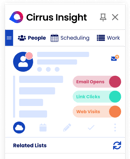
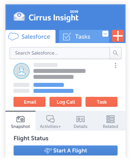
Built natively for Salesforce, Cirrus delivers conversation intelligence, live coaching, and automated meeting prep without requiring a separate intelligence layer bolted onto your CRM.
Instead of choosing between “basic and bundled” or “powerful and expensive,” Cirrus gives revenue teams:
- Automatic email & meeting sync into Salesforce
- AI-powered meeting summaries that update CRM records instantly
- Conversational intelligence insights tied directly to opportunities
- Live coaching nudges during calls
- Pre-call research automation before the meeting even starts
- Buyer signals and engagement tracking
- Smart Scheduler and sales cadences built into the workflow
Here’s the real difference:
- Einstein CI analyzes conversations but doesn’t deeply automate execution
- Gong analyzes conversations but sits on top of Salesforce as an additional layer
- Cirrus connects conversations, engagement, and CRM execution inside Salesforce
Gong vs. Salesforce: FAQs
Is Gong a CRM like Salesforce?
No. Gong is a conversation intelligence platform that analyzes sales calls and meetings using AI. Salesforce is a CRM system that manages accounts, contacts, opportunities, and forecasting. Gong enhances CRM data but does not replace Salesforce as a system of record.
Can Gong replace Salesforce?
No, Gong cannot replace Salesforce. While Gong provides deal insights and forecasting signals based on conversations, it relies on CRM data to function properly. Salesforce manages pipeline structure and revenue reporting, which Gong does not.
Which is better: Salesforce or Gong?
It depends on your goal. Salesforce is essential for managing pipeline, automation, and forecasting. Gong is best for analyzing sales conversations and coaching reps. High-performing revenue teams often use Salesforce as the foundation and layer conversation intelligence on top.
Does Salesforce offer conversation intelligence like Gong?
Salesforce offers Einstein Conversation Insights in certain editions, but it typically provides more limited conversational analysis compared to dedicated platforms like Gong. Teams looking for deeper coaching dashboards and advanced call intelligence often explore additional solutions.
How much does Gong cost compared to Salesforce?
Gong pricing typically starts around $1,200–$1,600 per user per year, depending on contract scope. Salesforce Sales Cloud pricing ranges from approximately $25 to $165+ per user per month depending on edition. Most teams pay for Salesforce first, then add conversation intelligence tools on top.
What are the top Gong competitors?
Top Gong competitors include Clari Copilot, Chorus by ZoomInfo, Avoma, and other conversation intelligence platforms. Some Salesforce-native tools also combine CRM automation, meeting intelligence, and live coaching into one workflow layer.
Can you use Gong without Salesforce?
Gong can integrate with multiple CRMs, but it performs best when connected to a structured CRM like Salesforce. Without accurate CRM data, forecasting insights and deal visibility may be limited.
Is there a Salesforce-native alternative to Gong?
Yes. Some platforms provide conversation intelligence, live coaching, automated meeting summaries, and CRM sync directly inside Salesforce. These tools aim to bridge the gap between CRM execution and conversation intelligence without adding another disconnected system layer.