|
Quick answer
Pick HubSpot if you're an SMB or growth-stage team that wants to be selling this week, with low setup and a lower bill. Pick Salesforce if you need deep customization, complex sales processes, and enterprise-grade AI, and you have admin resources to run it.
The 2026 twist: the AI gap narrowed. HubSpot's Breeze and Salesforce's Agentforce both ship autonomous agents now, so your real decision is about complexity, cost, and how much you plan to customize, not who has AI.
|
Most CRM comparisons skip the number that actually predicts success: adoption. Around 55% of CRM implementations miss their planned goals, and the top cause is poor user adoption, not the software.
We've watched this play out. A team buys the more powerful platform, reps quietly stop logging activity, and within a quarter the pipeline data is fiction. The tool was never the problem. The habit was.
So we'll compare HubSpot and Salesforce through that lens, not just features and price, but which one your team will actually use. By the end, you'll know which fits your stage, your budget, and your appetite for setup, plus the 2026 pricing and AI details most comparison posts still get wrong.
HubSpot vs Salesforce: Quick Comparison
Here's the side-by-side before we get into the details.
| |
HubSpot CRM
|
Salesforce CRM
|
|
Best for
|
SMBs to mid-market
|
Mid-market to enterprise
|
|
Ease of use
|
Fast setup, minimal admin
|
Steeper learning curve, usually needs an admin
|
|
Pricing model
|
Free CRM plus per-seat hubs
|
Per-user editions, higher floor
|
|
Customization
|
Straightforward, some limits
|
Deep, close to unlimited
|
|
Integrations
|
Strong native marketing stack
|
Largest marketplace (AppExchange)
|
|
Reporting
|
Clean dashboards, less granular
|
Enterprise-grade, highly detailed
|
|
AI (2026)
|
Breeze agents on every tier, incl. free
|
Agentforce autonomous agents on Einstein + Data Cloud
|
|
Starting paid price
|
$15 /seat/mo (Starter, annual)
|
$25 /user/mo (Starter Suite)
|
|
Scales to
|
Fast-growing SMBs
|
Global enterprises
|
|
Our take: if you want your team selling tomorrow, HubSpot's simplicity wins. If you want to model every corner of your sales process, Salesforce is the heavier machine. Both statements are still true in 2026.
|
Ease of Use: HubSpot's Simplicity vs Salesforce's Depth
These two take opposite approaches. One optimizes for getting started; the other for control.
HubSpot: Fast, Simple, and Hard to Misconfigure
HubSpot is one of the easiest CRMs to adopt. Most teams create pipelines, add contacts, and start tracking deals in an afternoon, with no technical help.
- Minimal setup: pipelines and deals are live in hours, not weeks.
- Clean interface: sales, marketing, and service tools stay clearly separated.
- Free training: HubSpot Academy carries a lot of the onboarding for non-technical teams.
- Low admin overhead: a sales manager can usually run it without a dedicated admin.
Real example: a 15-person startup sales team that wants to track deals this week can launch HubSpot with almost no disruption. That's the whole pitch, and it holds up.
Salesforce: Deep Customization, More to Manage
Salesforce is built for customization and scale, and that power shows up as complexity on day one.
- Steeper learning curve: setup and navigation can overwhelm new users.
- Admin support expected: most teams hire or train a Salesforce admin to manage configuration and integrations.
- Highly customizable: every workflow, field, and report can be tailored to the business.
- Enterprise-ready: role hierarchies, approval processes, and automation rules built for large orgs.
Here's what we see most often. Salesforce's flexibility is real, but it's also where adoption goes to die if nobody owns the setup. A global org running different processes across regions needs that depth. A 20-rep team usually pays for power it won't configure.
AI in 2026: HubSpot Breeze vs Salesforce Agentforce
This is where the comparison changed most since last year. Both platforms moved past "AI features" and shipped autonomous agents that can run multi-step work on their own. If a comparison still talks about "Einstein" or "content recommendations," it's out of date.
Salesforce Agentforce
Salesforce folded its older Einstein feature set into Agentforce, an autonomous-agent platform built on Einstein AI and Data Cloud. Agents run complex workflows across the whole Salesforce ecosystem, and the Atlas Reasoning Engine breaks a request into steps and checks its work before acting.
This is no longer a preview. By early 2026 Agentforce reached about 18,500 customers and 3 billion-plus agent workflows a month, and Salesforce reported Agentforce annual recurring revenue near $800M, up roughly 169% year over year. The Einstein predictive layer (lead and opportunity scoring, forecasting) still sits underneath, and it's genuinely strong when your Salesforce data is clean.
Cost: the AI-forward tier, Agentforce 1 Sales, is $550/user/mo. You can also add Agentforce to lower editions for roughly $125/user/mo, or take a $5/user/mo license billed per conversation. In other words, the best AI is real, but it's a line item on top of an already-higher base.
HubSpot Breeze
HubSpot's answer is Breeze, a single AI layer that spans every hub, including the free CRM. It bundles 100-plus embedded features plus agents like the Breeze Prospecting Agent (research and outreach) and Breeze Customer Agent (support). Data enrichment runs on HubSpot's Clearbit acquisition, and predictive lead scoring uses your own conversion history.
The difference in philosophy matters. Breeze is included and works out of the box, so smaller teams get useful AI without a project. Some agents run on HubSpot Credits, and in April 2026 HubSpot moved the Prospecting and Customer agents to outcome-based pricing (the Customer Agent bills around $0.50 per resolved conversation), which keeps entry costs low.
So Which AI Wins?
It depends on where you sit. For enterprises orchestrating agents across sales, service, and custom clouds, Agentforce is more powerful, and it should be at $550/user/mo. For SMBs and mid-market teams, Breeze delivers most of the value with none of the setup, at a fraction of the price.
|
One caveat that applies to both: an AI agent is only as good as the CRM history it learns from. If reps don't log activity, neither Breeze nor Agentforce can save you. That's the adoption problem again, and it's the reason this whole comparison keeps circling back to habits, not features.
|
Integrations and Ecosystem
Both connect to the usual stack (email, Slack, Zoom, LinkedIn), but the ecosystems differ in shape.
- HubSpot: a strong native marketing and sales stack plus the App Marketplace. Most SMBs find what they need out of the box, with little custom work.
- Salesforce: AppExchange is the largest marketplace in the category, with thousands of apps and deep connections into enterprise systems like ERP. In 2026 both platforms also added open-protocol support (including MCP) so external AI models can plug into CRM data.
Practically: if your integration needs are common, HubSpot gets you there faster. If you have niche or enterprise systems to connect, AppExchange is hard to beat. Migrating between the two is possible in both directions through APIs or partners; the effort scales with how customized your setup is.
Implementation and Adoption: What to Expect
CRM success is decided here, not on the feature grid. Remember the stat we opened with: most failed rollouts fail on adoption. The two platforms carry very different adoption curves.
HubSpot
- Live in days: small teams often track deals the same week they sign up.
- Little training needed: HubSpot Academy covers most of it.
- No dedicated admin required for most SMBs.
- Best for startups and SMBs that want fast time-to-value.
Salesforce
- Setup in weeks or months, often with a structured rollout.
- More onboarding for users and managers as customization grows.
- Usually needs a designated admin to run and optimize it.
- Best for mid-market and enterprise teams that can commit those resources.
HubSpot Pricing in 2026
HubSpot prices by hub, seat, and contact volume rather than by edition. The free CRM stays free for unlimited users; you pay when you need premium features. Here are the tiers that matter for most teams.
|
Plan
|
Approx. price (USD)
|
What you get
|
|
Free CRM
|
$0
|
Contact and deal tracking, pipelines, dashboards, and Breeze basics
|
|
Starter
|
$15 /seat/mo (annual)
$20 monthly
|
Core sales features, basic automation and sequences
|
|
Sales Hub Professional
|
$100 /seat/mo
+ $1,500 onboarding
|
Sequences, workflows, forecasting, custom reporting, Breeze agents
|
|
Sales Hub Enterprise
|
$150 /seat/mo
+ $3,500 onboarding
|
Advanced permissions, predictive scoring, conversation intelligence
|
|
Marketing Hub Pro
|
~$890 /mo
|
Deeper marketing automation, campaigns, reporting (contact tiers apply)
|
|
Marketing Hub Enterprise
|
~$3,600 /mo
|
Advanced automation, multi-team permissions, custom objects
|
What drives the cost: marketing contacts (billed in tiers), paid seats, which hubs you buy (or the bundled Customer Platform), and HubSpot Credits for some Breeze agents. HubSpot looks cheap at the free tier, but the bill climbs with contact volume and advanced automation.
What changed in 2026: Starter dropped to $15/seat, Breeze AI is now included across paid tiers, and the seat-based model was refined after INBOUND 2025.
Salesforce Pricing in 2026
Salesforce prices per user, per month, with most editions billed annually. In 2026 the Sales Cloud lineup is marketed under the Agentforce Sales name, and the tiers look like this.
|
Edition
|
Approx. price (USD/user/mo)
|
What you get
|
|
Starter Suite
|
$25
|
Core CRM: leads, contacts, opportunities, simple dashboards
|
|
Pro Suite
|
$100
|
Forecasting, more automation and reporting for growing teams
|
|
Enterprise
|
$175
|
Advanced customization, automation, APIs, role-based permissions
|
|
Unlimited
|
$350
|
Full platform, sandboxes, premium support, higher limits
|
|
Agentforce 1 Sales
|
$550
|
Autonomous AI agents woven through the workflow, top analytics
|
What changed since 2025: the old "Professional" tier is now Pro Suite and rose to $100 (it was $75). Salesforce also raised Enterprise and Unlimited list prices about 6% in August 2025, which is now baked into the numbers above. The AI tier that used to sit under "Einstein 1" is now Agentforce 1 Sales.
What drives the cost: every rep, manager, and admin needs a paid license. Then come the add-ons: web API is an extra ~$25/user/mo on Pro and below, Premier Support runs around 30% of net license fees, and storage, sandboxes, and Agentforce all bill on top. Implementation and admin time are often the largest hidden costs. The headline price is rarely the real bill.
What It Actually Costs: A Quick Reality Check
List prices only tell you so much, so run the simple math for a real team. Take 25 sales reps on each platform's common mid-market tier, at list price, before discounts, onboarding, or add-ons:
- HubSpot Sales Hub Professional: 25 seats x $100 x 12 = $30,000/year.
- Salesforce Enterprise: 25 users x $175 x 12 = $52,500/year.
That's a $22,500 annual gap at 25 people, and it widens as you scale or turn on AI. It doesn't make Salesforce a bad buy; it makes it a deliberate one. If you'll use the customization and enterprise reporting, the premium earns its place. If you won't, you're paying for a machine you'll run at half power.
Which CRM Is Right for You?
Both are strong. The right pick depends on your stage, resources, and goals. Use this checklist.
Choose HubSpot If
- You're a startup or small business that needs a CRM live in days, not weeks.
- You want a clean interface with minimal training.
- You don't have budget or headcount for a dedicated CRM admin.
- You want built-in sales and marketing automation under one roof.
- You value a free or low-cost entry, even if costs scale with contacts.
- You want capable AI included, not configured, through Breeze.
Choose Salesforce If
- You're scaling regionally or globally and need a CRM that grows with you.
- You want deep customization of workflows, fields, reports, and automation.
- You have (or will hire) admin resources to manage setup and optimization.
- You rely on enterprise-grade reporting, forecasting, and role-based visibility.
- You want the most powerful agentic AI and can budget for Agentforce.
One more filter: don't just buy for today. Picture the CRM you'll still want in three years. HubSpot wins on simplicity and speed; Salesforce wins on depth and scale. And plenty of teams run both, HubSpot for marketing and Salesforce for sales, if the budget supports it.
How Cirrus Insight Closes the Salesforce Adoption Gap
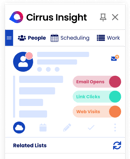
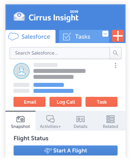
Say you land on Salesforce. You now own the more powerful platform, which means you also own the adoption risk we started with. This is the exact problem Cirrus Insight was built for, and it connects to Salesforce through Gmail, Outlook, and Teams.
Cirrus lives inside your inbox, so reps never have to switch tabs to keep the CRM current. It removes the manual logging that quietly kills adoption:
It starts at $14/user/mo and supports every Salesforce edition. The point isn't to replace Salesforce; it's to make sure the CRM you're paying for actually fills up with good data. See how Cirrus Insight works with Salesforce.
HubSpot vs Salesforce: FAQs
Is HubSpot Similar to Salesforce?
They overlap as CRMs, but they aim at different buyers. HubSpot is built for SMBs and mid-market teams that want fast setup and included AI. Salesforce is built for larger, more complex organizations that need deep customization and will invest admin time to get it. Same category, different center of gravity.
Which Is Better, Salesforce or HubSpot?
Neither wins outright. HubSpot is better for speed, simplicity, and cost at SMB and mid-market scale. Salesforce is better for customization, complex processes, and enterprise-grade AI and reporting. Match the tool to your stage and your appetite for setup.
Is HubSpot or Salesforce Better for Startups?
HubSpot, in most cases. The free CRM, fast setup, and built-in marketing make it an easy first CRM. Salesforce becomes more compelling as you scale and need heavier customization.
Can I Use Both HubSpot and Salesforce?
Yes, and many teams do, typically HubSpot for marketing automation and Salesforce as the sales system of record. The two sync through native connectors or middleware. It adds cost and a little complexity, but it's a common setup for companies that want the best of each.
Can I Migrate from HubSpot to Salesforce, or the Other Way?
Yes. Both allow data migration through APIs, third-party tools, or consulting partners. The complexity depends on how much data you're moving and how customized your setup is.
Which CRM Offers Better Customer Support?
HubSpot is known for strong onboarding and training (HubSpot Academy) with responsive support on paid tiers. Salesforce offers 24/7 options and a huge partner ecosystem, though faster response often means a higher-tier support plan.
What Hidden Costs Should I Watch For?
For HubSpot, watch contact-based pricing, HubSpot Credits for some Breeze agents, and add-ons for advanced reporting. For Salesforce, budget for admin resources, implementation, API and storage add-ons, and Agentforce pricing on top of your base license. On both, the license is rarely the whole bill.


.png?width=18&height=18&name=Vector%20(5).png)