I've lost more hours than I'd like to admit to the quiet kind of scheduling failure: one meeting turns into ten emails, a time zone slips, two calendars drift, and half a morning is gone. So I went looking for tools that take that work off my plate instead of adding to it.
For this guide, I researched a couple dozen AI scheduling assistants and hands-on tested the ones you can sign up for yourself, from calendar optimizers to booking tools to sales schedulers. For the enterprise and concierge options, I leaned on demos, vendor docs, and current user reviews instead. Here are the 10 that earned a spot, and who each one is actually for.
The 10 Best AI Scheduling Assistants at a Glance
- Cirrus Insight for scheduling tied to Salesforce execution
- Kronologic for scheduling sales leads at scale
- Motion for automatic task scheduling and daily plans
- Reclaim.ai for protecting focus time and habits
- Akiflow for pulling every task source into one calendar
- Trevor AI for time-blocking on a budget
- Lindy for an AI assistant that books meetings by email
- Calendly for high-volume booking links
- Microsoft Copilot for Microsoft 365 teams
10. Google Calendar for Google Workspace teams
What Is an AI Scheduling Assistant?
An AI scheduling assistant is software that manages meetings and calendar time for you. It handles availability, conflicts, time zones, and rescheduling with rules or AI, instead of leaving you to run the back-and-forth by hand. The label covers four fairly different jobs, and knowing which one you need is the fastest way to avoid buying the wrong tool.
The four types worth knowing:
- Calendar optimizers and time-blockers: Put your tasks on the calendar, defend focus time, and reshuffle when the day changes. Motion, Reclaim, Akiflow, and Trevor AI live here.
- Meeting coordinators: Handle the back-and-forth of booking with other people through a link or an assistant. Calendly and Lindy are examples on this list.
- Sales scheduling tools: Tie meetings to your CRM and pipeline so booking is part of selling, not a separate chore. Cirrus Insight and Kronologic fit here.
- Built-in suite assistants: AI scheduling baked into the email and calendar stack you already use. Microsoft Copilot and Google Calendar cover this.
|
Tool type
|
What it does best
|
Automation
|
Best fit
|
|
Calendar optimizers
|
Places tasks and protects focus time
|
Medium to high
|
People and teams with packed calendars
|
|
Meeting coordinators
|
Removes booking back-and-forth
|
Low to very high
|
High-volume or external booking
|
|
Sales scheduling tools
|
Ties meetings to the CRM
|
Medium to high
|
Sales and revenue teams
|
|
Built-in suite assistants
|
Light scheduling inside your stack
|
Low
|
Teams already on Microsoft or Google
|
How I Evaluated Each AI Scheduling Assistant
- Automation depth: Does it act, or only suggest? The more it can safely execute, the more time it gives back.
- Calendar intelligence: Focus-time protection, conflict resolution, buffers, and time-zone handling that actually holds up under pressure.
- Integrations: Google and Microsoft calendars, video links, task apps, and CRM where it matters to your workflow.
- Ease of setup: How fast you reach a first successful booking without needing a manual.
- Value: Price weighed against the hours it realistically saves, not the length of the feature list.
|
How I put this together: I write about sales productivity and scheduling for the Cirrus Insight blog. I researched roughly two dozen tools and personally tested the self-serve ones across a working week, setting up meetings, forcing conflicts, and watching how each one recovered. For enterprise and concierge tools I used demos, vendor documentation, and current third-party reviews.
One disclosure that matters: this article is published by Cirrus Insight, which is one of the tools reviewed. Cirrus is ranked first because it fits the sales-execution use case this blog serves, not because we published the page. Every tool here is judged on the same five criteria, and Cirrus carries the same honest cons as the rest.
|
The Best AI Scheduling Assistants Compared
|
Tool
|
Best for
|
Standout feature
|
Starting price
|
Website
|
|
Cirrus Insight
|
Scheduling tied to Salesforce
|
Meetings auto-logged to Salesforce
|
From $11/user/mo
|
Visit Cirrus Insight
|
|
Kronologic
|
Sales leads at scale
|
High-density automated invites
|
From $15/user/mo
|
Visit Kronologic
|
|
Motion
|
Automatic task scheduling
|
Auto-builds and reshuffles your day
|
From $19/user/mo
|
Visit Motion
|
|
Reclaim.ai
|
Protecting focus time
|
Defends habits and focus blocks
|
Free; from $10/user/mo
|
Visit Reclaim
|
|
Akiflow
|
One task inbox
|
Consolidates every task source
|
From $11/mo
|
Visit Akiflow
|
|
Trevor AI
|
Time-blocking on a budget
|
Generous free time-blocking
|
Free; Pro $5/mo
|
Visit Trevor AI
|
|
Lindy
|
An AI email assistant
|
Books meetings by email in plain language
|
From $29.99/mo
|
Visit Lindy
|
|
Calendly
|
High-volume booking links
|
Round-robin routing to the right rep
|
Free; from $10/seat/mo
|
Visit Calendly
|
|
Microsoft Copilot
|
Microsoft 365 teams
|
Scheduling inside Outlook and Teams
|
Add-on ~$18/user/mo
|
Visit Microsoft Copilot
|
|
Google Calendar
|
Google Workspace teams
|
Smart time and location suggestions
|
Free; Workspace from ~$7/user/mo
|
Visit Google Calendar
|
Best for Scheduling Tied to Salesforce Execution
Cirrus Insight (Gmail, Outlook, Salesforce, Web)
Category: Sales scheduling tool
Pros
- Books meetings with full CRM context
- Auto-logs activity to Salesforce, no manual entry
- Lead routing keeps reps' calendars full
Cons
- Value depends on Salesforce
- Smart Scheduler sits on the pricier Expert tier
- Occasional sync glitches and a dated UI
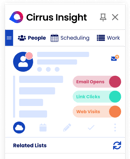
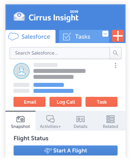
Cirrus Insight treats scheduling as part of sales execution, not a standalone calendar chore. It is the tool I reach for first when a team already lives in Salesforce, because unlike Calendly's standalone links or Kronologic's outbound blasts, every meeting it books writes straight back to the CRM.
The Smart Scheduler drops booking links into Gmail or Outlook, so a rep sets up a call without leaving the message they are replying to. Lead routing sends inbound prospects to the right rep's calendar using your own workflow rules, which keeps calendars full without a manager playing traffic cop. Because Cirrus syncs meetings, emails, and tasks to Salesforce automatically, the activity actually lands on the Lead, Contact, or Opportunity with nobody logging it by hand.
The catch is that the value depends on Salesforce. If your team is not on it, most of the point disappears, and there are cheaper tools for scheduling alone. The AI Smart Scheduler and lead routing also sit on the higher Expert tier, and some reviewers mention occasional sync hiccups and a UI that feels its age. For a Salesforce shop, though, that inbox-to-CRM loop is the whole reason to pick it.
Cirrus Insight pricing: Salesforce Sync from $14/user/mo; Pro $21/user/mo (adds meeting scheduling); Expert $49/user/mo (adds Smart Scheduler and lead routing); Enterprise custom. Free trial, no free plan.
Best for Scheduling Sales Leads at Scale
|
[Screenshot placeholder] Actual product UI of Kronologic. Alt text: "Screenshot of Kronologic's scheduling view."
|
Category: Sales scheduling tool
Pros
- Automated meeting scheduling for leads
- NLP detects and handles reschedule requests
- Can replace booking links for outbound
Cons
- Parts of the interface could be smoother
- Expensive
- Built narrowly for sales orgs
Kronologic sits on a different plane from the rest of this list. Where Cirrus books meetings from a rep's inbox with CRM context, Kronologic runs outbound scheduling at volume for sales teams chasing a big list of leads.
Instead of dropping a new lead into a queue and hoping a rep calls back at a sensible hour, Kronologic proposes a specific date and time automatically and emails the invite. If the lead replies to push it, the tool's natural language processing spots the reschedule intent and updates the invite without a human touching it.
Its high-density scheduling mode is the party trick. You load, say, 200 interested leads, set a meeting type and template, and it sends timed invites across a window. Most slots overlap on purpose, because the app tracks your historical conversion rate and knows not everyone shows. You end up talking to the leads who actually engage instead of dialing all 200 by hand. The honest limits: this is a specialist sales tool, not a personal calendar app, the interface could be tidier, and it is the priciest option here.
Kronologic pricing: From $15/user/mo.
Best for Automatic Task Scheduling and Daily Plans
Motion (Web, Windows, Mac, iOS, Android)
|
[Screenshot placeholder] Actual product UI of Motion. Alt text: "Screenshot of Motion's scheduling view."
|
Category: Calendar optimizer
Pros
- Strong automatic day planning
- Good priority and deadline-risk controls
- Reshuffles the calendar around changes
Cons
- Real learning curve
- Rigid if you dislike time-blocking
- Only as good as your task hygiene
Motion is the pick when you want your calendar to behave like a living plan rather than a static grid. It started as a smart calendar with strong project management and has grown into a wider AI workspace.
You feed it tasks and projects, and its AI Calendar schedules them into time blocks, then reshuffles automatically when a meeting runs long or an urgent task lands. If Reclaim is about defending your focus time, Motion is more about deciding what you work on next. The Projects and Tasks view breaks down everything you and your team owe, with risk labels that flip from on track to at risk as deadlines approach. Newer AI agents use your productivity data to optimize schedules, take meeting notes, and even document standard operating procedures.
There is a real learning curve, and Motion can feel rigid if you dislike time-blocking. The plan is also only as good as your task hygiene: feed it vague tasks, and it will schedule the wrong urgent work beautifully. Review your priorities regularly, and it earns its keep.
Motion pricing: Pro AI from $19/user/mo (teams, billed annually) or $29/mo for individuals; Business AI higher; no free plan.
Best for Protecting Focus Time and Habits
Reclaim.ai (Web (Google Calendar; Outlook in beta))
|
[Screenshot placeholder] Actual product UI of Reclaim.ai. Alt text: "Screenshot of Reclaim.ai's scheduling view."
|
Category: Calendar optimizer
Pros
- Excellent focus-time protection
- Habit scheduling that survives a chaotic week
- Good balance of control and automation
Cons
- No native mobile app
- Google-first (Outlook in beta)
- Rescheduling logic complex at first
Reclaim is the tool I pick when the calendar is technically working, but the brain is not, because meetings have eaten every gap. Now owned by Dropbox, it defends focus time and habits, then reshuffles them when conflicts hit.
During setup you weave in your habits and set how hard Reclaim should defend each one: Most flexible, Let Reclaim decide, or Most defensive. So a morning workout can be locked solid while learning time floats when a meeting pops up. The Planner screen keeps a calendar in the center with priority habits, open tasks, and low-priority habits down the side. It also protects deadlines and reschedules recurring 1:1s automatically when someone cancels, finding a slot that works for both people.
There is still no native mobile app, and it is Google-first with Outlook support in beta. The rescheduling logic can feel complex until you tell it clearly what wins between focus time and client calls. Set that priority once, and it stops fighting you.
Reclaim.ai pricing: Lite free (1 user); Starter $10/user/mo; Business $15/user/mo; Enterprise $22/user/mo (billed annually).
Best for Pulling Every Task Source Into One Calendar
Akiflow (Web, Windows, Mac, iOS, Android)
|
[Screenshot placeholder] Actual product UI of Akiflow. Alt text: "Screenshot of Akiflow's scheduling view."
|
Category: Calendar optimizer
Pros
- Strong cross-platform sync
- Single inbox for every task source
- Solid time-blocking and daily planning
Cons
- Expensive, no free plan
- AI sometimes needs explicit commands
- Native integrations still incomplete
Akiflow is for the operator whose tasks live everywhere: Slack, email, Notion, Asana, a project tool, and three browser tabs. Where Motion auto-plans and Reclaim defends focus, Akiflow's edge is pulling every one of those sources into a single cockpit.
You connect your calendar, pipe in the other platforms, and drag whatever you need to do onto the calendar to block time. Its AI labels each new task automatically as personal, work, or admin, so you can browse by label on the left and see what is piling up. A chat interface on the bottom right lets you command it to reschedule events or drop overdue tasks onto the calendar, though it sometimes needs an explicit instruction like place my overdue tasks. Built-in time tracking then delivers a daily report of where your hours actually went.
The native integrations do not cover every app yet, so heavy users lean on Zapier to fill the gaps. If your day is a firehose of task sources, though, the single inbox is the reason to try it.
Akiflow pricing: From $11/mo
Best for Time-Blocking on a Budget
Trevor AI (Web (Google, Microsoft, Todoist))
|
[Screenshot placeholder] Actual product UI of Trevor AI. Alt text: "Screenshot of Trevor AI's scheduling view."
|
Category: Calendar optimizer
Pros
- Unusually generous free plan
- Predicts task duration
- Simple, lightweight time-blocking loop
Cons
- Google, Microsoft, and Todoist only
- No mobile app
- Not built for team orchestration
Trevor AI is the budget entry point to time-blocking, and it is the one I would hand someone who wants to try the method without committing to a pricier suite like Motion or Akiflow.
Its Smart Planner syncs in real time with Google or Microsoft calendars so your agenda stays accurate across devices, and it predicts how long each task will take. The Smart Scheduling Queue prioritizes and schedules tasks for you, and the Task Hub lets you color-code lists, attach notes, and connect Todoist. You can chat with Trevor to bulk-schedule or get rescheduling suggestions for overdue work. The free plan is the standout: it includes scheduling suggestions and predicted durations that many competitors reserve for paid tiers.
It integrates only with Google, Microsoft, and Todoist, so it is a poor fit if your stack lives elsewhere, and there is no mobile app. It is also not built for team scheduling orchestration. For a solo planner watching costs, that is a fair trade.
Trevor AI pricing: Free plan; Pro $5/mo.
Best for an AI Assistant That Books Meetings by Email
Lindy (Web, email, Slack, iMessage)
|
[Screenshot placeholder] Actual product UI of Lindy. Alt text: "Screenshot of Lindy's scheduling view."
|
Category: Meeting coordinator
Pros
- Handles the conversation of scheduling, not just logic
- Lives in email and Slack
- Context-aware across your tools
Cons
- No free tier, only a 7-day trial
- Credit-metered cost is hard to predict
- Needs oversight, not hands-off automation
Lindy is closer to an AI teammate than a calendar plugin. It repositioned in 2026 as a general AI executive assistant, and scheduling is one of the jobs you can hand it. Like Cirrus, it can act inside your inbox, but Lindy is a general assistant rather than a Salesforce-native tool.
You build agents, called Lindys, in plain language that triage email, schedule and reschedule meetings across time zones, join calls to take notes, and update a CRM. Its strength is the social layer of scheduling, the polite back-and-forth, rather than pure calendar logic, and it works where scheduling actually happens: email, Slack, and even iMessage.
There is no free tier anymore, just a 7-day trial, and the pricing runs on a credit-metered system underneath the plan prices, which makes the real monthly cost hard to predict. Billing surprises are the most common complaint in its reviews. And because it acts on real inboxes, it rewards oversight rather than fully unattended automation.
Lindy pricing: Plus $29.99/mo; Pro $99.99/mo; Max $199.99/mo; Enterprise custom. 7-day trial, no free plan.
Best for High-Volume Booking Links
Calendly (Web, iOS, Android, browser extension)
|
[Screenshot placeholder] Actual product UI of Calendly. Alt text: "Screenshot of Calendly's scheduling view."
|
Category: Meeting coordinator
Pros
- Extremely easy to use
- Widely adopted and trusted
- Strong integrations
Cons
- Reactive, not proactive
- AI features are still incremental
- Per-seat cost climbs; free plan capped at 1 event type
Calendly is the default booking-link tool for a reason, and it is the one to beat when your problem is high-volume booking rather than calendar optimization.
You set availability, share a link, and invitees pick a slot while both calendars update. For teams it adds round-robin, routing, and collective event types, so leads land with the right rep. It integrates with Zoom, Google Meet, and Teams, and with Salesforce on the Teams plan.
Calendly is reactive. It waits for someone to open a link; it will not proactively rearrange your week the way Motion or Reclaim will, and its AI features are still incremental. The per-seat cost climbs as the team grows, and the free plan caps you at a single event type. If you want booking plus CRM write-back, Cirrus or Kronologic fit a sales team better; if you want an assistant to negotiate times, Lindy does that.
Calendly pricing: Free; Standard $10/seat/mo; Teams $16/seat/mo (billed annually); Enterprise custom.
Best for Microsoft 365 Teams
|
[Screenshot placeholder] Actual product UI of Microsoft Copilot. Alt text: "Screenshot of Microsoft Copilot's scheduling view."
|
Category: Built-in suite assistant
Pros
- Native Microsoft 365 integration
- Strong enterprise adoption
- Nothing new to learn
Cons
- Assistive, not autonomous
- Best value only inside Microsoft
- Add-on cost on top of a base plan
Microsoft Copilot brings AI scheduling into Microsoft 365, and for an Outlook-and-Teams shop it is the least disruptive option because there is no new tool to learn.
Inside Outlook and Teams it suggests meeting times, pulls agenda context, and helps with meeting prep, grounded on your organization's data through Microsoft Graph. For teams already standardized on Microsoft 365, that native reach is the selling point.
Copilot is assistive rather than autonomous. It suggests and drafts; it will not run your calendar the way a dedicated scheduler does. The value is also mostly locked inside the Microsoft stack, and it is an add-on cost on top of a qualifying base plan, so budget for both lines. If you need genuine autonomy, Motion or Lindy go further; Copilot's advantage is that it already sits in the tools your team uses.
Microsoft Copilot pricing: Add-on about $30/user/mo enterprise, or $18-$21/user/mo for business (promotional), on top of a qualifying Microsoft 365 plan; Copilot Chat is free for eligible users.
Best for Google Workspace Teams
|
[Screenshot placeholder] Actual product UI of Google Calendar. Alt text: "Screenshot of Google Calendar's scheduling view."
|
Category: Built-in suite assistant
Pros
- Native and intuitive
- No extra cost
- Strong ecosystem
Cons
- Limited automation
- No autonomous scheduling
- Suggestions only
Google Calendar's AI features cover the small scheduling decisions inside a tool your team already opens fifty times a day. It is the right pick when good enough and free beats another subscription.
It offers smart suggestions for meeting times and locations, and it ties into Gmail and Meet so booking a call is a couple of clicks. For anyone on Google Workspace, that native, no-extra-cost convenience is hard to argue with.
Set expectations, though. This is suggestive, not autonomous. There is no auto-scheduling of tasks, no focus-time defense, and no real workflow automation. For that, you would add Reclaim or Motion on top. Think of Google Calendar as the base layer that the calendar optimizers on this list improve.
Google Calendar pricing: Free with a personal Google account; included with Google Workspace (business plans from about $7/user/mo).
Honorable Mention
CalendarHero: an email-and-calendar scheduler that automates the back-and-forth of booking. I left it off the main list because it shows signs of decline (third-party directories rank it low and reviewers report some non-functional features), and its use case overlaps Lindy and Calendly. Worth a look only if it fits an existing workflow.
How to Choose the Right AI Scheduling Assistant
- If your team runs on Salesforce, start with Cirrus Insight; scheduling that writes back to the CRM saves the most downstream cleanup. For high-volume outbound, compare it with Kronologic.
- If your calendar is full but your focus is shot, Reclaim or Motion will defend and rebuild your day.
- If you juggle tasks from a dozen apps, Akiflow consolidates them; on a tight budget, Trevor AI covers the basics.
- If you just need people to book you without the email chain, use Calendly at scale, or Lindy if you want an assistant to handle the conversation.
- If you would rather not add a tool, Microsoft Copilot or Google Calendar cover the light stuff inside the suite you already use.
Turn Scheduling Into Sales Execution
There is no single best AI scheduling assistant, and anyone who tells you otherwise is selling something. The right pick comes down to a few honest questions: are you on Salesforce, are you solving for one person or a whole team, how much booking volume do you handle, and what can you spend. Match the tool to that, not to a feature list.
If you are a sales team, the harder part usually is not finding a slot. It is making sure the meeting happens with context, gets logged correctly, and turns into the right follow-up. That is the specific gap Cirrus Insight fills: smart scheduling inside Gmail and Outlook, meetings tied to Salesforce Leads, Contacts, and Opportunities, and no manual logging afterward. If your calendar is full but your pipeline is not moving, start a free trial of Cirrus Insight and see how scheduling that feeds the CRM changes the follow-through.
|
About the author: Ryan O'Connor writes about sales productivity, Salesforce workflows, and scheduling for the Cirrus Insight blog. [Add author headshot and credentials before publishing.]
|
AI Scheduling Assistant FAQs
What Is an AI Scheduling Assistant?
An AI scheduling assistant helps schedule, reschedule, and manage meetings by reading your availability, priorities, and rules, so you spend less time on back-and-forth and calendar conflicts.
How Is an AI Scheduling Assistant Different From Basic Scheduling Software?
AI assistants proactively manage your calendar and resolve conflicts, while basic scheduling software is reactive and waits for booking links and manual input.
What Is the Best AI Scheduling Assistant?
It depends on the job. Motion and Reclaim optimize your time, Calendly leads on booking links, and Cirrus Insight is the pick for sales teams that need scheduling tied to Salesforce.
What Is the Best AI Scheduling Assistant for Sales Teams?
Sales teams get the most from tools that add context and follow-up, like Cirrus Insight, which ties meetings to Salesforce records, and Kronologic for high-volume lead scheduling.
Are AI Scheduling Assistants Secure?
Most follow standard security practices, but review permissions, data access, and compliance before connecting your calendar, email, or CRM.
Are There Free AI Scheduling Assistants?
Yes. Reclaim, Trevor AI, Calendly, and Google Calendar all have free tiers, though the deeper automation usually sits on paid plans.
Related Reading


.png?width=18&height=18&name=Vector%20(5).png)