.png?width=18&height=18&name=Vector%20(5).png)
When revenue starts slipping, most teams look in one of two places:
- Are our reps saying the right things?
- Or are we reaching enough sales prospects in the first place?
That’s exactly where the Gong vs Salesloft debate begins.
Gong built its reputation on analyzing sales conversations, breaking down what top performers say, spotting deal risk signals, and giving managers real coaching data.
Salesloft, on the other hand, became a category leader in sales engagement, helping SDRs and AEs structure outreach, automate cadences, and scale activity across email, calls, and tasks.
Both platforms are powerful. Both are enterprise-tier. And both promise to improve revenue performance.
But they solve fundamentally different problems.
So the real question isn’t just “Which is better?” The real question is:
- Do you need better conversations?
- Or better engagement execution?
- Or something that connects execution, intelligence, and CRM accuracy together?
In this guide, we’ll break down Gong vs Salesloft features, pricing, use cases, and sales enablement capabilities and help you decide which platform actually fits your revenue motion in 2026.
What Is Gong?
Gong is a conversation intelligence platform built to analyze sales calls, demos, and revenue conversations at scale.
Instead of focusing on how many emails were sent or how many tasks were completed, Gong focuses on what was actually said during buyer interactions and what those conversations reveal about deal health, rep performance, and revenue risk.
At its core, Gong does three things:
- Records and transcribes sales calls
- Uses AI to generate summaries and extract key themes
- Surfaces insights that help managers coach reps and forecast more accurately
Gong’s Core Strength: Conversation Intelligence
Gong is strongest when you want visibility into:
- Objection handling patterns
- Talk-to-listen ratios
- Competitive mentions
- Deal risk signals
- Coaching opportunities across the team
Sales leaders use Gong to answer questions like:
- Why are deals stalling?
- What are top performers doing differently?
- Are reps missing buying signals?
In short, Gong gives you deep insight into conversations, not just activity metrics.
Where Gong Fits Best
Gong is typically best for:
- Enterprise sales organizations
- Enablement-driven teams
- Managers focused on coaching and performance improvement
- Companies prioritizing conversation-based revenue intelligence
What Is Salesloft?
If Gong analyzes what happens inside the conversation, Salesloft focuses on what happens before and after it.
Salesloft is a sales engagement platform designed to help revenue teams structure and automate outbound and follow-up workflows. It gives SDRs and AEs a systemized way to manage cadences, send emails at scale, track tasks, and keep outreach consistent.
Where Gong answers, “What did the rep say?” Salesloft answers, “Did the rep execute the process?”
Salesloft’s Core Strength: Structured Engagement
Salesloft is strongest when you need:
- Multi-step email cadences
- Task automation
- Call + email sequencing
- Activity tracking
- Rep productivity dashboards
It’s built for repeatability. For high-volume teams, especially outbound-heavy SDR organizations, that structure is valuable. It reduces guesswork and ensures no lead gets ignored.
Where Salesloft Fits Best
Salesloft typically works well for:
- SDR-driven outbound teams
- Organizations focused on scaling activity
- Teams that need strict cadence management
- Revenue leaders prioritizing process consistency
Gong vs Salesloft: Quick Comparison Overview
At a high level, Gong and Salesloft solve different parts of the revenue equation.
Gong is built for conversation intelligence, analyzing calls, surfacing coaching insights, and identifying deal risk.
Salesloft is built for sales engagement, structuring outreach, managing cadences, and driving activity at scale.
If your biggest problem is what reps are saying, Gong leans stronger.
If your biggest problem is how consistently reps are executing outreach, Salesloft has the edge.
Here’s a fast, side-by-side breakdown:
|
Feature |
Gong |
Salesloft |
Best For |
|
Primary focus |
Conversation intelligence |
Sales engagement & cadences |
Depends on revenue motion |
|
Call recording & AI transcription |
Yes (core strength) |
Limited |
Coaching & performance visibility |
|
Outbound sequencing |
No |
Yes (multi-step cadences) |
SDR-driven teams |
|
AI summaries |
Advanced, call-based |
Limited |
Managers & enablement |
|
CRM integration |
Strong (Salesforce, others) |
Strong (Salesforce, others) |
CRM-dependent teams |
|
Forecasting influence |
Indirect (deal risk signals) |
Indirect (activity insights) |
Enterprise sales orgs |
|
Workflow type |
Post-call analysis |
Pre- and post-call engagement |
Different jobs |
Quick Verdict Preview
- Choose Gong if you want deep coaching visibility and conversation analytics
- Choose Salesloft if you need structured outreach and cadence automationautomatio
- Consider Salesforce-native automation if you want engagement + meeting intelligence + automatic CRM accuracy in one workflow
Feature Comparison: Gong vs Salesloft
Now we move beyond headlines.
Because while both platforms support revenue teams, they operate in completely different lanes. And when you evaluate Gong vs. Salesloft features, the differences become much clearer.
Sales Engagement & Outreach Capabilities
This is where Salesloft was built to win.
Salesloft provides structured, repeatable engagement workflows that help SDRs, sales managers and AEs execute consistent outreach at scale.
With Salesloft, you get:
- Multi-step email cadences
- Task automation and reminders
- Call + email sequencing
- Template libraries
- Activity dashboards
For outbound-heavy teams, that structure reduces missed follow-ups and enforces process discipline.
Gong, on the other hand, is not a sequencing tool. It doesn’t build cadences or automate outbound workflows. It assumes outreach already happened and then analyzes what followed.
If engagement scale is your priority Salesloft leads.
If insight after engagement matters more Gong takes over.
Conversation Intelligence & Coaching
Conversation intelligence is Gong’s home turf.
Gong captures sales calls, transcribes them with AI, and analyzes conversation patterns across your team. It helps answer questions like:
- Are reps handling objections effectively?
- Are buyers mentioning competitors?
- Who’s dominating the conversation?
- Which deals show risk signals?
Key Gong strengths include:
- AI-generated call summaries
- Keyword and topic tracking
- Talk-to-listen ratios
- Objection detection
- Competitive intelligence
- Coaching dashboards
Salesloft offers some call tracking and engagement reporting, but it doesn’t provide the same depth of conversational analysis.
If you’re investing heavily in enablement and coaching, Gong is stronger here.
CRM Integration & Data Accuracy
Both platforms integrate with Salesforce and other CRMs, but integration isn’t the same as automation.
Gong syncs call data and insights into CRM records. Salesloft logs activity and cadence performance.
However, both still rely heavily on reps maintaining CRM hygiene.
If reps forget to update opportunity stages or log accurate deal notes, forecasting and reporting can suffer, regardless of which tool you use.
This is where teams often realize that integration alone doesn’t guarantee clean data.
Revenue Forecasting Alignment
Neither Gong nor Salesloft is a full forecasting governance platform.
- Gong influences forecasting indirectly through deal risk signals derived from conversations.
- Salesloft influences forecasting through activity visibility and engagement metrics.
But neither replaces structured revenue governance tools.
If your core goal is executive-level forecast accuracy, you may need deeper forecasting systems layered on top or stronger CRM automation underneath.
Gong vs Salesloft Pricing (2026 Estimates)
Both Gong and Salesloft are positioned as enterprise-grade revenue platforms, which means neither is priced like a lightweight SMB tool. Pricing is typically custom-quoted, based on team size, feature access, and contract length.
That said, based on verified buyer reports and industry benchmarks, here’s what revenue teams can realistically expect.
Gong Pricing (Estimated Range)
Gong typically operates on annual enterprise contracts.
Estimated cost range:
- $100–$160 per user per month
- Enterprise contracts commonly exceed $50,000–$100,000+ per year
Pricing depends on:
- Number of recorded users
- Conversation intelligence features
- Coaching dashboards
- CRM integrations
- Multi-year agreements
Gong is priced as a premium conversation intelligence platform, especially for mid-market and enterprise teams.
Salesloft Pricing (Estimated Range)
Salesloft also uses annual subscription pricing.
Estimated cost range:
- $75–$125 per user per month
- Enterprise contracts often range from $40,000–$90,000+ per year
Pricing varies based on:
- Number of users
- Cadence and sequencing capabilities
- Conversation add-ons
- Advanced analytics modules
Salesloft is positioned as an enterprise sales engagement suite, particularly for outbound-heavy teams.

Why Cirrus Insight Is the Smarter Alternative
Gong focuses on conversation intelligence.
Salesloft focuses on sales engagement.
But most revenue teams need both, plus clean Salesforce data and better meeting prep.
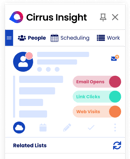
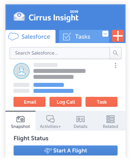
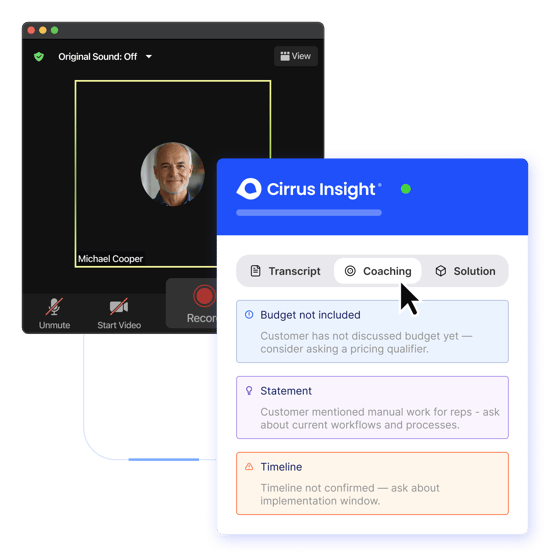
Cirrus Insight combines engagement, conversation intelligence, and AI-powered meeting prep in one Salesforce-native platform.
With Cirrus Insight, you get:
- Automatic email and meeting sync with Salesforce: Every interaction logs to the correct lead, contact, or opportunity
- AI-powered meeting summaries tied to deal records: Not stored in another dashboard, embedded inside your CRM
- Automated task creation and follow-up tracking: Action items don’t get forgotten
- Buyer Signals and email tracking: See who opened emails, clicked links, or engaged with attachments, and prioritize accordingly
- Smart Scheduler with intelligent routing: Eliminate scheduling friction while keeping CRM data clean
- Sales Cadences built inside your inbox: Structured follow-up without switching tools.
Instead of choosing between engagement or intelligence, Cirrus connects both, before, during, and after every meeting, while keeping your CRM accurate and up to date.
For Salesforce-driven teams, it’s not just an alternative. It’s a more unified way to run revenue.
Gong vs Salesloft FAQs
What is the main difference between Gong and Salesloft?
The main difference is focus. Gong is a conversation intelligence platform that analyzes sales calls and provides coaching insights, while Salesloft is a sales engagement platform designed to structure outbound cadences and automate outreach workflows.
Is Gong better than Salesloft?
Gong is better for teams prioritizing call analysis, coaching, and deal risk visibility. Salesloft is better for teams focused on scaling outbound engagement and enforcing structured cadences. The right choice depends on your sales motion.
Can Gong replace Salesloft?
No, Gong does not replace Salesloft because it does not provide outbound sequencing or sales engagement automation. Gong analyzes conversations, while Salesloft manages outreach workflows.
Does Salesloft offer conversation intelligence like Gong?
Salesloft offers limited call tracking and analytics, but it does not provide the same depth of AI-driven conversation intelligence, coaching dashboards, and deal risk analysis that Gong delivers.
Which is better for Salesforce users: Gong or Salesloft?
Both integrate with Salesforce, but they rely on accurate CRM data to function effectively. Teams that want deeper Salesforce-native automation and automatic activity sync may benefit from platforms that prioritize CRM accuracy alongside engagement and conversation intelligence.
What is the difference between sales engagement and conversation intelligence?
Sales engagement tools like Salesloft focus on structuring outreach through cadences and automation. Conversation intelligence tools like Gong analyze recorded sales calls to provide insights into rep performance, buyer behavior, and deal risk.
Are Gong and Salesloft expensive?
Yes, both Gong and Salesloft are enterprise-tier platforms typically priced per user per month under annual contracts. Total investment often reaches tens of thousands of dollars per year depending on team size and feature requirements.
What is an alternative to Gong and Salesloft?
Teams looking for a unified solution may consider Salesforce-native platforms that combine sales engagement, AI meeting prep, conversation insights, and automatic CRM sync in one workflow, reducing tool sprawl and improving execution efficiency.