.png?width=18&height=18&name=Vector%20(5).png)


Most sales calls aren’t lost on the call.
They’re lost before it even starts.
A rep joins five minutes early. Skims the CRM. Glances at LinkedIn. Hopes the conversation “flows naturally.”
It rarely does.
Top performers don’t wing it. They walk into every conversation knowing:
- Who they’re speaking to
- What matters to them
- Where the deal stands
- What the objective is
- And exactly what “success” looks like for that call
That’s sales call preparation.
And it’s one of the biggest differentiators between average reps and consistent closers.
Buyers today are informed, busy, and skeptical. If you don’t show up with context, relevance, and direction, you don’t get a second chance. But when you prepare strategically, everything changes, your confidence improves, your questions get sharper, objections feel manageable, and your close rate climbs.
In this guide, you’ll learn:
- What sales call preparation actually means
- A practical pre sales call preparation checklist
- A reusable sales call preparation template
- Common mistakes that kill deals
- How AI tools can automate research and boost call confidence
What is Sales Call Preparation, and Why it Matters More Than Ever
Sales call preparation is the structured process of researching, planning, and defining objectives before speaking with a prospect or customer.
It means walking into a call with context. With intention. With a strategy. Not just a script.
Pre-sales call preparation directly impacts your close rate because it shapes the quality of your questions, the relevance of your messaging, and your ability to guide the conversation. When reps skip preparation, they default to generic pitches.
The cost of “winging it” is subtle but expensive as it might result in:
- Missed buying signals
- Weak objection handling
- Unclear next steps
- Longer sales cycles
- Lower win rates
On the flip side, effective sales call planning improves:
- Confidence as you’re not scrambling for answers
- Objection management as you anticipate resistance
- Deal velocity as you define clear next steps
- Credibility as buyers feel understood
The 7-Step Sales Call Preparation Checklist
High-performing reps don’t prepare randomly. They prepare systematically.
This sales call preparation checklist ensures every call is intentional, relevant, and designed to move the deal forward, not just “have a good conversation.”
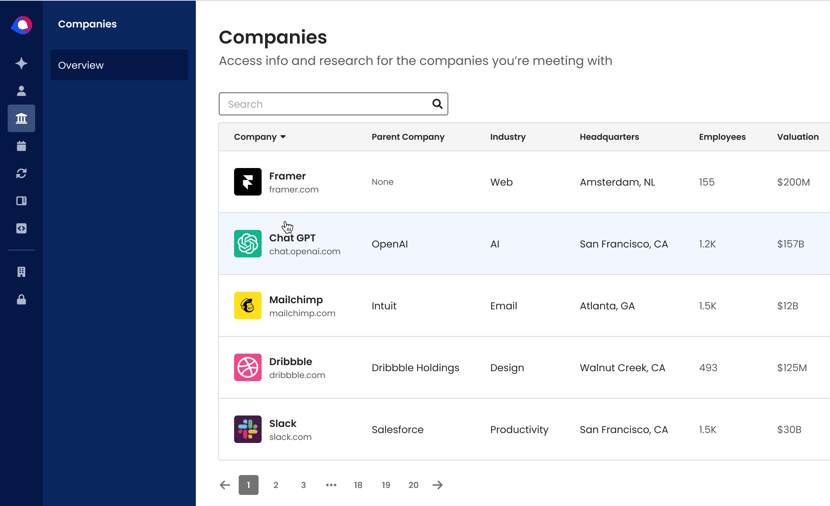
1. Research the Company (Beyond the Homepage)
Basic prep is knowing what the company does.
Advanced prep is understanding what’s changing inside that company.
Before the call, identify:
Industry Trends
- Are they in a high-growth or declining market?
- Are regulatory changes affecting them?
- Are competitors consolidating or expanding?
This allows you to frame your solution in a macro context.
Recent News
- Product launches
- Leadership changes
- Acquisitions
- Press releases
Opening with, “I saw your recent expansion into EMEA…” immediately builds credibility.
Growth Signals
- Job postings (hiring SDRs? scaling support?)
- New office locations
- Technology stack expansion
- Website traffic spikes (if available)
Growth creates urgency. Stagnation creates different pain.
Funding or Financial Indicators
- Recently funded startups have budget and momentum.
- Public companies may be under margin pressure.
Context shapes positioning.
2. Understand the Buyer Persona (Not Just Their Job Title)
Selling to a VP of Sales is different from selling to a CFO.
Go deeper than the title.
Role & KPIs
Ask: How is this person measured?
- Revenue?
- Cost reduction?
- Efficiency?
- Risk mitigation?
Decision-Making Power
- Are they the economic buyer?
- Influencer?
- End user?
- Champion?
If they can’t sign, your goal may be equipping them internally.
Pain Points
- What problems does someone in this role typically face?
- What initiatives are they likely responsible for?
Use language that reflects their pressure, not your product features.
Stakeholder Influence
- Who else will weigh in?
- IT?
- Finance?
- Operations?
Map the internal politics before you walk in.
3. Review CRM Activity & Past Interactions
This is where most reps under-prepare.
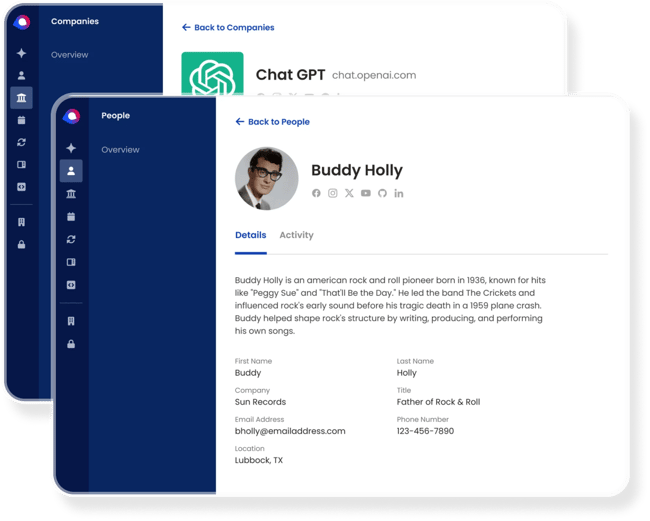
Your CRM is a goldmine if it’s accurate. When reps surface trends from recent Salesforce opportunity activity, they walk into the call with context, not assumptions. That context shapes smarter questions, tighter positioning, and stronger next steps.
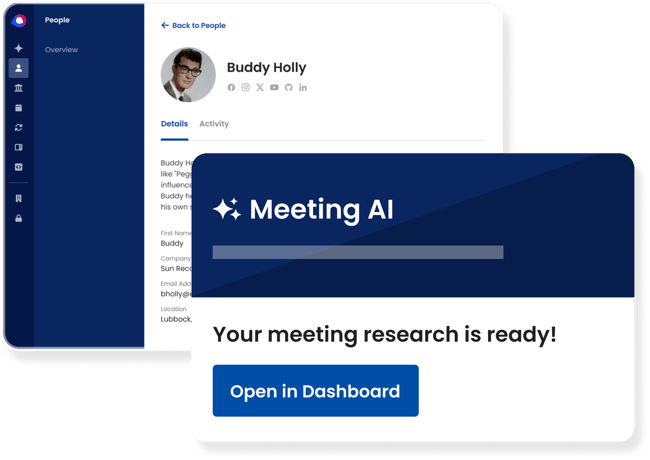
If you want those insights automatically surfaced before every meeting, tools like Meeting AI can compile CRM activity, past interactions, and opportunity data into a structured pre-call summary, eliminating manual prep while improving accuracy.
Review:
Email History
- What tone has been used?
- What topics resonated?
- Were there delays in replies?
Patterns reveal interest level.
Previous Objections: If pricing was mentioned twice before, don’t act surprised when it comes up again.
Notes from Past Meetings
- What commitments were made?
- What timeline was discussed?
- What metrics were mentioned?
Nothing kills credibility like asking something they already answered.
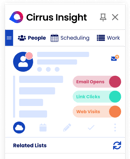
Engagement Signals
- Email opens
- Link clicks
- Attachment views
- Website visits
High engagement = opportunity to accelerate.
Low engagement = adjust your approach.
This is where CRM sync tools and email tracking systems matter. If activity isn’t logged automatically, prep becomes guesswork. Automated CRM syncing ensures you walk into the call with complete context, not partial data.
4. Define Your Call Objective (One Clear Outcome)
Every sales call must have one primary objective.
Not five.
Ask yourself: “If this call goes perfectly, what happens next?”
Examples:
- Book a product demo
- Confirm budget availability
- Secure stakeholder introduction
- Move from discovery to proposal
- Close the deal
If your objective is vague (“have a good conversation”), the call will drift.
Clarity creates direction. Direction creates momentum.
5. Prepare Strategic Questions (Control Through Curiosity)
The best sales calls are question-led.
Prepare questions that uncover:
Problem Depth
- “How are you currently solving this?”
- “What happens if nothing changes?”
Surface consequences.
Budget Qualification
- “Is there already budget allocated for this initiative?”
- “How do investments like this typically get approved?”
Avoid surprise pricing objections later.
Decision Process Clarity
- “Who else will be involved in evaluating this?”
- “What does your internal approval timeline look like?”
Prevent deal slippage.
Urgency Triggers
- “Is there a specific deadline driving this?”
- “What happens if this isn’t solved this quarter?”
Without urgency, deals stall.
Preparation here gives you control without sounding scripted.
6. Anticipate Objections (Before They Happen)
Elite reps prepare rebuttals before the call begins.
Common objections include:
Pricing
Prepare ROI positioning, cost-of-inaction framing, or phased rollout options.
Competition
Know how competitors position themselves and where they’re weak.
Timing
If they say “next quarter,” have questions ready: “What changes between now and then?”
Internal Resistance
If multiple stakeholders are involved, anticipate internal skepticism.
Rehearse your responses mentally. Confidence increases when you’ve already processed the likely friction.
7. Plan Your Next Step (Before the Call Ends)
The biggest mistake in sales call preparation?
Not defining the next move ahead of time.
Before the call, decide:
Your Ideal CTA
- Book demo
- Send proposal
- Schedule stakeholder meeting
- Start trial
Follow-Up Timeline
- Same-day recap?
- 48-hour proposal?
- One-week check-in?
Success Metric
How will you measure whether this call worked?
- Stakeholder intro secured?
- Budget confirmed?
- Timeline clarified?
Preparation doesn’t end when the call begins. It ends when the next step is locked in.
Sales Call Preparation Template (Free Framework)
Preparation becomes powerful when it’s repeatable.
Instead of relying on memory or scattered notes, use a structured sales call preparation template before every important conversation. This framework keeps reps aligned, focused, and outcome-driven.
You can copy this into your CRM, Notion, Google Doc, or internal playbook.
Sales Call Preparation Template
Company: (Industry, size, recent news, growth signals)
Contact name & role: (Title, KPIs, influence level, decision-making authority)
Deal stage: (Discovery, demo, evaluation, proposal, closing)
Call objective: (What must happen for this call to be successful?)
Example: Secure budget confirmation and schedule technical validation call.
Known pain points: (What problems are they trying to solve? What pressure are they under?)
Key questions to ask:
- Problem depth question:
- Budget/process question:
- Timeline/urgency question:
- Stakeholder question:
Value positioning angle: (How will you frame your solution specifically for this persona and company?)
Example: Focus on reducing manual admin time to improve sales productivity.
Likely objections:
- Pricing
- Competition
- Timing
- Internal approval
(Prepare concise rebuttal positioning for each.)
Desired next step: (Specific, measurable CTA)
Example: Book 30-minute demo with Head of Operations by Friday.
Prepare Smarter Sales Calls with Cirrus Insight
Sales call preparation shouldn’t feel like detective work.
Reps shouldn’t have to dig through email threads, switch between tabs, manually review CRM notes, and piece together context five minutes before a meeting. That’s not preparation, that’s scrambling.
The difference between average and elite performance often comes down to consistency. And consistency requires systems.
That’s where Cirrus Insight gives your team a measurable advantage.
With Cirrus Insight, your reps can:
- Automatically sync emails, meetings, and tasks to Salesforce
- Access full CRM context directly inside Gmail or Outlook
- View engagement data like email opens and attachment tracking
- Generate AI-powered pre-meeting summaries
- Capture notes and action items in real time
- Eliminate manual data entry after every call
Instead of spending 20–30 minutes preparing for each call manually, reps walk in informed, confident, and focused on the objective.
Instead of incomplete CRM records, managers get accurate pipeline visibility.
Instead of reactive conversations, your team leads proactive, data-driven sales calls.
Sales Call Preparation FAQs
How do you prepare for a sales call?
Sales call preparation involves researching the company and buyer, reviewing CRM history, defining a clear call objective, preparing strategic questions, and planning the next step. Effective sales call preparation ensures the conversation is relevant, focused, and outcome-driven rather than reactive.
What should be included in a sales call preparation checklist?
A sales call preparation checklist should include company research, buyer persona insights, past interaction review, call objectives, key discovery questions, anticipated objections, and a defined next step. Using a structured checklist improves confidence, reduces surprises, and increases close rates
What is pre sales call preparation?
Pre sales call preparation is the planning and research process completed before speaking with a prospect. It includes reviewing CRM data, identifying stakeholder influence, analyzing pain points, and aligning your value proposition to the buyer’s priorities.
What is a sales call preparation sheet?
A sales call preparation sheet is a structured document that organizes all key information for a call, including deal stage, known challenges, questions to ask, objections to anticipate, and desired outcomes. It helps sales reps stay focused and consistent across meetings.
Is there a sales call preparation template I can use?
Yes, a sales call preparation template typically includes fields for company insights, contact role, deal stage, call objective, key questions, likely objections, and next steps. Using a reusable template standardizes preparation and improves team performance.
How long should sales call preparation take?
Sales call preparation should typically take 10–30 minutes depending on deal complexity and stage. Using CRM integrations and AI-powered tools can significantly reduce prep time while improving the quality of insights.
Why is sales call preparation important?
Sales call preparation improves credibility, strengthens objection handling, and shortens sales cycles. Buyers expect personalized, informed conversations, and preparation ensures you show up with relevant context instead of generic messaging.
How can AI improve sales call preparation?
AI improves sales call preparation by generating pre-meeting summaries, pulling CRM context automatically, highlighting engagement signals, and extracting action items. This reduces manual research and ensures consistent, data-driven preparation before every call.
How does Cirrus Insight improve sales call preparation?
Cirrus Insight improves sales call preparation by automatically syncing emails and meetings with Salesforce, providing CRM context directly inside the inbox, and using Meeting AI to generate structured pre-call summaries. This eliminates manual prep work and ensures reps walk into every call informed and confident.