I have spent the last decade watching Salesforce bolt AI onto every corner of its platform, and 2026 is the year the names finally caught up with the ambition. Einstein GPT and Einstein Copilot are gone, folded into Agentforce, and half the stack got renamed around it.
For more detail, explore our agentforce assistant guide.
To write this, I worked through Salesforce's own release notes, tested the tools our team uses day to day, and cross-checked pricing and product changes against primary sources, because a lot of what ranks for this topic is a year out of date.
Below are the 15 Salesforce AI tools worth knowing right now, what each is genuinely best for, and where each one still falls short.
The 15 Best Salesforce AI Tools at a Glance
- Agentforce for autonomous AI agents across sales and service
- Einstein Lead & Opp Scoring for predictive lead and deal prioritization
- Einstein Forecasting for AI sales forecasting
- Einstein Prediction Builder for no-code custom predictions
- Einstein Next Best Action for real-time recommended actions
- Einstein for Developers for AI-assisted Apex and LWC development
- Agentforce Studio for customizing and grounding your AI
- Data 360 for the AI data foundation
- Tableau Einstein for AI-powered analytics and visualization
- Agentforce in Slack for AI in team collaboration
- Agentforce Service Agent for AI customer service
- Einstein Activity Capture for automated email and calendar logging
- Einstein Conversation Insights for AI analysis of sales calls
- Cirrus Insight for inbox-native AI and Salesforce data hygiene
- ChatGPT for general-purpose generative help alongside Salesforce
What is Salesforce AI?
Salesforce AI is the set of artificial intelligence built into the Salesforce platform. It spans predictive features that score and forecast from your CRM history, generative features that draft content and code, and agentic features that can take action on their own.
Because it runs natively, it can act on the same records your team already works in, grounded in your own data through Data 360. Together, these capabilities combine predictive and generative AI to support each practical use case, from lead generation to service and revenue operations.
For more detail, explore our linkpoint 360 guide.
The tools split into six sub-types:
- Agentic AI platforms: Autonomous agents that reason over data and take action, not just suggest it.
- Predictive Einstein tools: The scoring, forecasting, and recommendation features that rank and predict from your CRM history.
- Generative and developer AI: Tools that draft content or code, and the builders that let you shape them. These generative AI capabilities help teams personalize content while maintaining a repeatable workflow.
- Data and analytics AI: The grounding layer and the analytics that turn unified data into visible insight.
- Activity and conversation AI: Tools that capture and analyze emails, calls, and meetings.
- Third-party AI for Salesforce: Non-native tools that integrate with Salesforce and often fill a native gap.
How I judged these tools
- Genuine AI capability: Is it actually predictive, generative, or agentic, or a rules-based feature wearing an AI label?
- Native Salesforce fit: Does it work inside the CRM or sync straight to it, or does it need heavy custom plumbing?
- Data grounding and accuracy: How well does it use trustworthy CRM data, and how does it behave when the data is messy or duplicated?
- Cost and licensing clarity: What is included in your edition versus a paid add-on, and is the pricing predictable?
- Time to value: How fast can a team switch it on and see a result?
About this guide. This roundup is published by Cirrus Insight, which is one of the 15 tools reviewed (entry 14). I held our own product to the same five criteria as everything else here, including its limitations, and I did not rank it first. No vendor paid for placement. Product facts were checked against Salesforce release notes and primary sources in 2026; pricing is flagged for confirmation because it changes often.
The Best Salesforce AI Tools Compared
|
Tool
|
Best for
|
Category
|
Standout feature
|
Starting price
|
Website
|
|
Agentforce
|
autonomous AI agents across sales and service
|
Agentic AI platforms
|
Atlas autonomous action engine
|
Free Foundations tier; usage-based
|
Visit
|
|
Einstein Lead & Opp Scoring
|
predictive lead and deal prioritization
|
Predictive Einstein tools
|
1-99 predictive deal scores
|
Included in Sales Cloud (varies)
|
Visit
|
|
Einstein Forecasting
|
AI sales forecasting
|
Predictive Einstein tools
|
AI-projected forecast ranges
|
Revenue Intelligence add-on
|
Visit
|
|
Einstein Prediction Builder
|
no-code custom predictions
|
Predictive Einstein tools
|
No-code custom prediction models
|
Einstein add-on / higher editions
|
Visit
|
|
Einstein Next Best Action
|
real-time recommended actions
|
Predictive Einstein tools
|
Rule-plus-AI action recommendations
|
Included in many editions
|
Visit
|
|
Einstein for Developers
|
AI-assisted Apex and LWC development
|
Generative and developer AI
|
Natural-language Apex and test generation
|
Varies by edition
|
Visit
|
|
Agentforce Studio
|
customizing and grounding your AI
|
Generative and developer AI
|
Grounded custom prompt and model building
|
With Agentforce / Einstein licensing
|
Visit
|
|
Data 360
|
the AI data foundation
|
Data and analytics AI
|
Unified zero-copy customer profiles
|
~$60k/year Starter (flag)
|
Visit
|
|
Tableau Einstein
|
AI-powered analytics and visualization
|
Data and analytics AI
|
Tableau Pulse insights in Slack
|
Tableau licensing (varies)
|
Visit
|
|
Agentforce in Slack
|
AI in team collaboration
|
Agentic AI platforms
|
Agent access and AI summaries in Slack
|
Slack AI add-on
|
Visit
|
|
Agentforce Service Agent
|
AI customer service
|
Agentic AI platforms
|
Autonomous, knowledge-grounded service
|
Usage-based (flag)
|
Visit
|
|
Einstein Activity Capture
|
automated email and calendar logging
|
Activity and conversation AI
|
Native-record email and calendar sync
|
Included in Sales Cloud
|
Visit
|
|
Einstein Conversation Insights
|
AI analysis of sales calls
|
Activity and conversation AI
|
Talk-to-listen call analysis
|
Sales Cloud Einstein add-on
|
Visit
|
|
Cirrus Insight
|
inbox-native AI and Salesforce data hygiene
|
Third-party AI for Salesforce
|
Inbox-native sync to standard objects
|
from ~$14/user/mo (flag)
|
Visit
|
|
ChatGPT
|
general-purpose generative help alongside Salesforce
|
Third-party AI for Salesforce
|
General generative AI plus CRM query beta
|
Free/Plus (OpenAI)
|
Visit
|
Order groups tools by sub-type, not rank. There is no single best tool; the right pick depends on your edition, data readiness, and budget.
1. Best for Autonomous AI Agents Across Sales and Service
Agentforce (Agentforce 360) (Salesforce Platform, Slack, Data 360)
Category: Agentic AI platforms
Agentforce is the tool Salesforce now puts at the center of everything, and it replaced Einstein Copilot in late 2024. This reflects how Salesforce’s AI strategy has shifted toward enterprise-grade agents and trusted AI. If Einstein made predictions, Agentforce takes action. It runs on the Atlas reasoning engine and can work a case end-to-end: identify a customer by email, pull their open cases, draft a reply, and update the record, all without a rep clicking through screens.
At Dreamforce 2025, Salesforce renamed much of its stack around it, so Data Cloud became Data 360 and Service Cloud became Agentforce Service. The Einstein scoring tools tell a rep what to do next, but Agentforce can go and do it. You build agents in Agentforce Builder using Topics, Actions, and Instructions, and the Einstein Trust Layer handles data masking and guardrails.
Salesforce reported roughly $800M in Agentforce ARR by Q4 FY26, but third-party analysis suggests fewer than 10% of its 150,000-plus customers have scaled an agent past a pilot, and most production deployments take five to eleven months.
Independent reviews put out-of-box answer accuracy around 35% before tuning, which is why data quality and a Data 360 investment tend to decide whether Agentforce works for you. Pricing is unusual too: you pay per conversation or per action, not per seat.
Key features
- Atlas reasoning engine
- Agentforce Builder (Topics, Actions, Instructions)
- Prebuilt sales, service, and voice agents
- Einstein Trust Layer guardrails
- Grounding through Data 360
Pros
- Genuinely autonomous multi-step actions
- Prebuilt agents for sales and service
- Trust Layer masking and guardrails
Cons
- Long road to production
- Requires a lot of training for the AI work
- Real value needs a Data 360 budget
- Challenging for most Salesforce orgs due to required CRM hygiene
- Usage pricing is hard to forecast
Agentforce pricing: Free Foundations tier; about $2 per conversation, or Flex Credits at $500 per 100,000 (roughly $0.10 per standard action). Data 360 and Einstein add-ons are extra. Confirm current rates with Salesforce.
2. Best for Predictive Lead and Deal Prioritization
Einstein Lead and Opportunity Scoring (Sales Cloud)
Category: Predictive Einstein tools
This is the Einstein feature most sales teams meet first, and it does one thing well. For teams exploring Einstein for Sales, it is a clear example of how lead scoring and predictive prioritization can guide daily decisions.
It scores every lead and open opportunity from 1 to 99 based on the patterns in your own closed-won and closed-lost history. A rep opening a list view sees which deals actually resemble past wins, so they stop spending Tuesday chasing a lead that was never going to convert.
Opportunity Scoring is now free in most editions, which is a real change from a few years ago when it sat behind the Sales Cloud Einstein add-on. Teams that use Einstein can apply this scoring to improve prioritization and optimize rep attention. Unlike Agentforce it does not act for you, and unlike Cirrus Insight further down this list it does not capture the activity data in the first place. It reads whatever is already in Salesforce and ranks it. This becomes a major roadblock if current opportunity data is not up to date, acurrate or complete.
That dependency is also the catch. Scoring quality tracks data quality, so if reps are not logging emails and calls, the model is guessing from a thin record. It also needs a minimum volume of history before the numbers mean anything, and the factors behind a score can feel like a black box to a rep who just watched a deal drop a tier.
Key features
- 1-99 lead and opportunity scores
- Score factors shown on the record
- Tiered High, Medium, Low scores in Pipeline Inspection
- List-view and report integration
Pros
- Free opportunity scoring in most editions
- Scores sit right on the record
- Learns from your own win patterns
Cons
- Needs clean, complete activity data
- Requires minimum historical volume
- Score factors can feel opaque
Einstein Lead & Opp Scoring pricing: Opportunity Scoring is included in most Sales Cloud editions; the full Sales Cloud Einstein feature set may need Unlimited or an add-on. Confirm with Salesforce.
3. Best For AI Sales Forecasting
Einstein Forecasting (Revenue Intelligence) (Sales Cloud, Revenue Intelligence)
Category: Predictive Einstein tools
Einstein Forecasting brings AI to the number every sales leader argues about. Instead of a rep's gut call rolled up in a spreadsheet, it predicts where the quarter lands based on pipeline trends and your own historical close behavior, then shows a projected range you can plan against.
Paired with Pipeline Inspection and Revenue Intelligence, it gives managers week-over-week changes, close-date predictions, and deals that look at risk. It consumes the same scored pipeline that Einstein Opportunity Scoring produces and turns it into a forecast, so the two work as a pair.
The prediction is only as trustworthy as your pipeline hygiene, so stale close dates and missing activity quietly wreck accuracy. The richer Revenue Intelligence capabilities also sit in higher editions or a paid add-on rather than base Sales Cloud, so budget for that before you promise leadership a smarter forecast.
Key features
- AI-projected forecast ranges
- Close-date predictions
- Week-over-week pipeline changes
- Revenue Intelligence dashboards
Pros
- More grounded than spreadsheet forecasts
- Flags at-risk deals early
- Pairs with opportunity scoring
Cons
- Accuracy tracks pipeline hygiene
- Best features need an add-on
- Setup takes configuration
Einstein Forecasting pricing: Available with higher Sales Cloud editions or the Revenue Intelligence add-on. Confirm with Salesforce.
4. Best for No-Code Custom Predictions
Einstein Prediction Builder (Salesforce Platform)
Category: Predictive Einstein tools
Einstein Prediction Builder is for the admin who wants a custom prediction without a data scientist. It brings practical machine learning into an admin-led process without requiring a separate modeling team. You pick a Salesforce object, say Invoice, choose the outcome you want to predict such as late payment or churn, and Einstein trains a model on your historical records and drops a prediction score right on the record.
It is genuinely no-code, and that is the point. You can stand up a likely-to-churn field and use it in reports, dashboards, and flows without writing a line. Where it fits versus the scoring tools above, Lead and Opportunity Scoring predict conversion out of the box, but Prediction Builder lets you predict anything your data supports.
The catch is the same as every predictive tool here. It needs a healthy volume of clean historical records to produce a model worth trusting, predictions on custom objects only go as far as your data quality, and reading a model responsibly still takes some care so you do not act on a confident but shaky score.
Key features
- No-code model builder
- Predictions on standard and custom objectsBinary or scored outcomes
- Usable in reports, flows, and automation
Pros
- Truly no-code
- Works on custom objects
- Outputs usable in automation
Cons
- Needs a volume of clean data
- Quality tracks your records
- Model literacy still helps
Einstein Prediction Builder pricing: Available with higher Salesforce editions or an Einstein add-on. Confirm with Salesforce.
5. Best for Real-Time Recommended Actions
Einstein Next Best Action (Salesforce Platform)
Category: Predictive Einstein tools
Einstein Next Best Action puts a recommendation right on the record, telling a user what to do next rather than leaving them to guess or dig through a playbook. Think of it as Netflix-style suggestions for CRM. A service agent handling an unhappy customer near renewal might see a prompt to offer a two-year contract with a discounted add-on, generated from rules you define plus predictive signals like a churn score.
You build strategies that combine business rules with Einstein predictions, then surface a ranked offer or action the user can trigger in one click. It is the layer that turns the scores from Prediction Builder and Opportunity Scoring into a concrete next step, short of full Agentforce autonomy.
The quality of the recommendations depends on the strategy rules you write, so a lazy setup produces generic advice. And it recommends rather than acts, so a human still has to click. It is a nudge engine, not an autonomous agent.
Key features
- Rule-plus-prediction strategies
- Recommendations on any record
- One-click actions
- Ranked offers
Pros
- Concrete next steps on the record
- Blends rules and predictions
- One click to act
Cons
- Only as smart as your strategies
- Recommends, does not act
- Setup takes planning
Einstein Next Best Action pricing: Available across many Salesforce editions; advanced use may need add-ons. Confirm with Salesforce.
6. Best for AI-Assisted Apex and LWC Development
Einstein for Developers (VS Code, Salesforce Code Builder)
Category: Generative and developer AI
Einstein for Developers is Salesforce's coding assistant, built on its own CodeGen model and living inside VS Code and Code Builder. You describe what you need in plain English, like a method that checks an account's credit score, and it drafts the Apex. It autocompletes as you type, explains inherited code line by line, and generates test classes, which is the feature most Salesforce developers actually reach for.
In head-to-head reviews from the Salesforce community, it now wins on Apex test-class generation, while general tools like GitHub Copilot still lead on raw Lightning Web Components and JavaScript. This is the native option, so it understands Apex conventions and stays inside the trusted Salesforce environment rather than sending code to an outside service.
It is confined to the Salesforce ecosystem, so it is less useful the moment you step outside Apex and metadata, and its LWC suggestions still trail dedicated code assistants. For a Salesforce-only shop that is a fair deal; for a mixed stack, you will likely run it alongside a general assistant.
Key features
- Natural language to Apex
- Inline autocomplete
- Line-by-line code explanation
- Unit test generation
- Code Analyzer integration
Pros
- Best-in-class Apex test generation
- Runs inside VS Code
- Stays in the Salesforce trust boundary
Cons
- Limited outside the Salesforce stack
- LWC support trails Copilot
- Needs prompt discipline
Einstein for Developers pricing: Availability varies by edition and Agentforce or Einstein licensing. Confirm with Salesforce.
7. Best for Customizing and Grounding Your AI
Agentforce Studio (Prompt Builder and Model Builder) (Salesforce Platform)
Category: Generative and developer AI
Agentforce Studio, which grew out of Einstein 1 Studio, is where you customize Salesforce AI instead of just using what ships in the box. Prompt Builder lets an admin create reusable, grounded prompts, so a draft-a-renewal-email prompt pulls in real fields from the record rather than generic filler.
Model Builder lets you bring your own large language model or use Salesforce's, and Agent Builder is where the Agentforce agents themselves get assembled.
Everything else on this list is a finished tool, while this is the workbench that shapes them, which is why it earns its own entry. If you have felt boxed in by out-of-the-box Einstein behavior, this is the layer that removes the ceiling.
Prompt engineering, grounding, and testing take real effort and admin skill, and a badly grounded prompt doesn't produce. This rewards teams willing to invest in setup, not teams looking for something that works on day one with no tuning.
Key features
- Prompt Builder for grounded, reusable prompts
- Model Builder and bring-your-own-LLM
- Agent Builder
- Einstein Trust Layer integration
Pros
- Removes the out-of-box ceiling
- Grounds prompts in real data
- Bring your own model
Cons
- Assumes builder skill
- Grounding takes effort
- Bad prompts fail confidently
Agentforce Studio pricing: Tied to Agentforce and Einstein licensing and consumption. Confirm with Salesforce.
8. Best For The AI Data Foundation
Data 360 (formerly Data Cloud) (Salesforce Platform)
Category: Data and analytics AI
Data 360, which Salesforce called Data Cloud until the 2025 rebrand, is the least flashy tool here and quietly the most important. It supports a unified Customer 360 view that helps teams unify records and understand customer behavior. It unifies customer data from across your systems into one profile, so an AI agent or a scoring model reasons over a complete picture instead of whatever happens to be in the immediate record.
This is the grounding layer Agentforce leans on, and Salesforce recommends it for any production-grade agent. Nothing else on this list performs at its best without clean, unified data, which is the theme running through every entry here, so Data 360 is the foundation the rest sit on. It uses a zero-copy approach to reach data where it lives and can generate calculated insights and propensity scores.
The Starter SKU lists around $60,000 a year, and real deployments routinely climb into six figures once credits, storage, and operations add up, so this is the budget line buyers most often underestimate. Salesforce has loosened the hard requirement over time and basic agents can run on standard CRM data, but serious AI work tends to pull you here eventually.
Key features
- Unified customer profiles
- Zero-copy data access
- Calculated insights and propensity scores
- Grounding for Agentforce
Pros
- One profile across systems
- Grounds AI in real data
- Zero-copy access without full replication
Cons
- Six-figure cost at scale
- Underestimated in budgets
- Consumption pricing is complex
Data 360 pricing: Starter SKU lists around $60,000 per year and scales into six figures with credits and storage. Confirm current pricing with Salesforce.
9. Best for AI-Powered Analytics and Visualization
Tableau Einstein (Tableau Next) (Salesforce Platform, Slack)
Category: Data and analytics AI
Tableau Einstein, the version of Tableau now built on the Salesforce platform with Agentforce inside it, is where analytics stops being a report you request and starts being an answer that finds you. This AI-driven layer can improve personalization by turning patterns into decisions. It uses AI to surface insights, then pushes them into the flow of work through Tableau Pulse, which delivers automated, personalized metrics in plain language inside Slack, Salesforce, or wherever you already work.
Data 360 unifies the data and Tableau Einstein is the layer that makes sense of it visually and conversationally. A sales leader can ask why average order value is dropping and get a chart plus a suggested cause rather than a raw dashboard to interpret alone.
This is a heavier platform than the point tools above; it carries its own licensing and learning curve, and the newest agentic pieces are still maturing. Expect the capability set to keep shifting as Salesforce ships, and plan for analyst time to get real value out of it.
Key features
- Agentic analytics on the Salesforce platform
- Tableau Pulse automated insights
- Natural-language querying
- AI-assisted semantic models
- Insights delivered in Slack and Salesforce
Pros
- Insights in the flow of work
- Natural-language analytics
- Grounded in Data 360
Cons
- Heavier platform and licensing
- Real learning curve
- Agentic features still maturing
Tableau Einstein pricing: Tableau licensing is separate from core CRM and varies by deployment. Confirm with Salesforce.
10. Best for AI in team collaboration
Agentforce in Slack (Slack AI) (Slack)
Category: Agentic AI platforms
Slack has quietly become the front door to Salesforce AI. In 2026 it is the main place people actually talk to Agentforce agents, ask questions of CRM data, and get AI summaries without opening Salesforce at all. Slack AI adds conversation summaries and search across your messages, and because Slack is wired into Data 360 and the core platform, an agent can surface an opportunity summary or trigger an action inside a channel.
Where it fits, the other tools here live in Salesforce, while this meets people where they already spend the day, which is often the difference between AI that gets used and AI that gets ignored.
The richest capabilities assume you are already a Salesforce and Agentforce customer, so a standalone Slack workspace gets far less. And Slack AI features sit behind their own paid add-on rather than coming free with every plan, so check what your tier includes before you promise the team summaries.
Key features
- Agentforce agents in channels
- Slack AI conversation summaries
- AI search across messages
- CRM insights and actions in Slack
Pros
- Meets teams where they work
- Summaries and AI search
- Wired into Data 360
Cons
- Best value needs Agentforce
- Slack AI is a paid add-on
- Limited without Salesforce
Agentforce in Slack pricing: Slack AI is priced as a separate add-on, and Agentforce usage is billed separately. Confirm with Salesforce.
11. Best for AI Customer Service
Agentforce Service Agent (Einstein Bots) (Agentforce Service (Service Cloud))
Category: Agentic AI platforms
On the service side, Salesforce evolved from Einstein Bots, its long-running chatbot builder, to Agentforce Service Agent, an autonomous agent that can resolve customer issues on its own rather than following a rigid decision tree.
For teams evaluating Einstein for Service, this shows how AI can help move from scripted responses to resolution. The older Einstein Bots handled routine questions across chat, SMS, Slack, and Messenger using intent detection. The Service Agent goes further, reasoning over knowledge articles and case data to answer and act, escalating to a human only when it should.
Where it fits, this is Agentforce pointed specifically at the support queue, distinct from the sales-focused agents in entry one. If your team drowns in repetitive tickets, this is the entry aimed at you.
The limits are the ones that shadow all of Agentforce. It needs a well-maintained knowledge base and clean case data to answer reliably; independent testing has flagged modest out-of-box accuracy before tuning, and per-conversation pricing means a busy support line carries a real, variable cost. Einstein Bots' older licensing also capped conversations, so check what your edition actually includes.
Key features
- Autonomous case resolution
- Knowledge-grounded answers
- Multichannel: chat, SMS, Slack, messaging
- Clean human escalation
- Intent detection
Pros
- Resolves routine cases autonomously
- Works across channels
- Escalates to humans cleanly
Cons
- Needs a strong knowledge base
- Accuracy varies before tuning
- Per-conversation cost adds up
Agentforce Service Agent pricing: Agentforce per-conversation or Flex Credits; older Einstein Bots ran via a Digital Engagement license. Confirm with Salesforce.
12. Best for Automated Email and Calendar Logging
Einstein Activity Capture (Sales Cloud, Gmail, Outlook)
Category: Activity and conversation AI
Einstein Activity Capture, or EAC, connects a rep's Gmail or Outlook to Salesforce and logs emails and calendar events automatically, so nobody copy-pastes an email into a record. Within a broader Salesforce CRM strategy, that capture can reduce manual work across the stack. It is one of the most widely used Einstein features, and for years it had one flaw that shaped every evaluation: captured emails lived in an external AWS store, visible on the timeline but invisible to reports, flows, and APIs.
The Summer '25 release changed that with a feature called Sync Email as Salesforce Activity, which writes new emails as native Task and EmailMessage records you can finally report on and trigger automations from. You can even feed those emails into Agentforce and Prompt Builder to draft replies or read sentiment.
The migration is one-way and only backfills 180 days, so older email history stays trapped in the legacy layer, and native emails now consume Salesforce data storage, which can push you into overage costs at high volume.
Record matching also misfires when duplicate accounts or contacts exist, which is common, and Activity 360 Reporting retires in Summer '26, so the reporting picture is still moving. This is exactly the gap that tools like Cirrus Insight target by writing activity into standard objects from the start.
Key features
- Automatic, server-side email and calendar capture
- Sync Email as Salesforce Activity (native records)
- Header-only or full-email capture option
- Contacts and events stored as standard records
Pros
- Automatic capture, no rep effort
- Now reportable via native records
- Included with most Sales Cloud editions
Cons
- Only 180-day backfill on migration
- Native emails consume data storage
- Matching fails on duplicate records
Einstein Activity Capture pricing: EAC Standard is included with Sales Cloud editions, capped around 100 users with 6-month retention (24 months on higher tiers). Confirm with Salesforce.
13. Best for AI analysis of sales calls
Einstein Conversation Insights (Sales Cloud, Sales Engagement)
Category: Activity and conversation AI
Einstein Conversation Insights, once called Einstein Call Coaching, takes recorded sales calls and turns them into something a manager can coach from. It transcribes the conversation, flags mentions of competitors, pricing, and next steps, and shows talk-to-listen ratios so a rep can see they spent 80% of a discovery call talking.
This is the native answer to third-party conversation intelligence, and it overlaps with what Cirrus Insight's Conversation Intelligence does on the inbox side. Where it earns its place, if your calls already run through Sales Engagement or a supported dialer, the insights land on the opportunity with no extra vendor.
Coverage depends on which calls actually get recorded and captured, coaching still needs a human to act on the flags, and the depth of analysis is narrower than dedicated platforms like Gong that build their whole product around this one job.
Key features
- Call transcription
- Keyword and competitor mention tracking
- Talk-to-listen ratios
- Insights surfaced on the opportunity
Pros
- Native, no extra vendor
- Keyword and competitor flags
- Talk-listen coaching data
Cons
- Only as good as call capture
- Narrower than dedicated tools
- Still needs manual coaching
Einstein Conversation Insights pricing: Available with Sales Cloud Einstein or Sales Engagement tiers. Confirm with Salesforce.
14. Best for Inbox-Native AI and Salesforce Data Hygiene
Cirrus Insight (Gmail, Outlook, Salesforce, Teams)
Category: Third-party AI for Salesforce
Full disclosure, since it matters: Cirrus Insight publishes this guide, and I have held it to the same criteria as everything else here, cons included. Cirrus is a third-party layer that sits in Gmail and Outlook and keeps Salesforce clean without reps doing data entry.
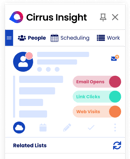
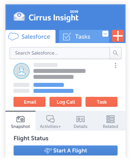
Its AI features have grown up over the last year. Meeting AI auto-researches who you are meeting and builds a brief, CRM AI queues up opportunity hygiene for one-tap updates, Conversation Intelligence analyzes calls and meetings, and Buyer Signals surface intent like repeated opens or a forwarded proposal.
Where it fits against the native tools, Einstein Activity Capture, back in entry twelve, has struggled for years to make captured email reportable, and Cirrus writes activity straight into standard Salesforce objects, which is the specific gap it targets. It also feeds the clean, complete data that Einstein scoring and Agentforce depend on, so it works alongside them rather than replacing them.
The Gmail experience runs as a browser extension, so it inherits browser quirks and the occasional bug. Some reviewers say it logs so much that it adds to Salesforce storage, useful features like scheduling sit in higher tiers, and cancellation requires 30 days' notice. It is a sales-team productivity layer, not a full agentic platform like Agentforce.
Key features
- Meeting AI research briefs
- CRM AI one-tap hygiene
- Conversation Intelligence
- Buyer Signals
- Direct sync to standard Salesforce objects
- Smart Scheduler and Email Blast
Pros
- Writes activity to standard objects
- Inbox-native AI briefs and signals
- Feeds clean data to Einstein and Agentforce
Cons
- Browser-extension quirks on Gmail
- Can add to Salesforce storage
- Top features sit in higher tiers
Cirrus Insight pricing: Third-party sources list Salesforce Sync from about $14/user/month, Pro around $21, and Expert around $49, plus a custom tier; the Cirrus pricing page emphasizes build-your-own per-seat pricing. Confirm current pricing directly with Cirrus Insight.
15. Best for General-Purpose Generative Help Alongside Salesforce
ChatGPT (via AppExchange and the Agentforce Sales app) (Web, AppExchange, ChatGPT)
Category: Third-party AI for Salesforce
ChatGPT earns a spot because so many Salesforce teams already use it. As a general AI CRM companion, it can support outreach and drafting tasks, although it is not a replacement for purpose-built AI for Sales. Admins draft validation-rule logic in plain English, reps rewrite outreach, and developers ask it to explain a gnarly formula. As of the Spring '26 release, Salesforce and OpenAI got closer: an Agentforce Sales app in ChatGPT reached open beta, letting reps query CRM data from inside a ChatGPT conversation.
Unlike every native tool here, ChatGPT is not grounded in your Salesforce data by default, which is both its strength and its weakness. It is excellent for open-ended drafting and explanation, and weak the moment you need an answer tied to a specific record without a deliberate connection.
Out of the box, it has no access to your CRM, so anything you paste in raises a data-governance question, and its Salesforce-specific knowledge trails purpose-built tools like Einstein for Developers on Apex conventions. Treat it as a capable generalist that complements the native stack, not a replacement for it.
Key features
- General-purpose generative AI
- Plain-language drafting and code help
- Agentforce Sales app in ChatGPT (beta) for CRM queries
- API integration via AppExchange
Pros
- Excellent open-ended drafting
- New CRM query beta with Agentforce
- Already familiar to most teams
Cons
- Not CRM-grounded by default
- Data-governance care needed
- Trails native tools on Apex
ChatGPT pricing: Free tier available; ChatGPT Plus and enterprise plans are priced by OpenAI, and the Agentforce app requires Salesforce licensing. Confirm current pricing.
Honorable Mentions
These are real Salesforce AI tools that did not make the main list because they are scoped to a specific cloud or audience, but they are worth knowing:
- Einstein for Marketing (Marketing Cloud): Predictive segmentation, send-time optimization, and content selection, but scoped to Marketing Cloud rather than the core CRM.
- Commerce AI (Commerce Cloud): Product recommendations, predictive sort, and commerce insights for Salesforce Commerce Cloud stores.
- Einstein Discovery (CRM Analytics): AI-driven pattern discovery and what-if analysis inside CRM Analytics, strong but analyst-oriented.
- Einstein Search: Personalized, AI-ranked search across Salesforce, now on by default in most editions.
Which Salesforce AI tool should you choose?
There is no single best Salesforce AI tool, and anyone who tells you otherwise is selling something. The right choice depends on whether you need Salesforce Einstein AI, the Salesforce Lightning Platform, a third-party layer, or another form of native Salesforce capability. Agentforce is the headline, but it only pays off with clean data and a real Data 360 budget.
The Einstein predictive tools deliver value fast if your pipeline hygiene is solid. The third-party options fill gaps the native stack still leaves open. Start with your edition (what you already own), your data readiness (the single biggest predictor of AI success here), and your budget, then pick the one or two tools that close your most expensive gap first.
Every tool on this list runs on the same fuel: complete, accurate CRM data. That is where Cirrus Insight fits. It keeps Salesforce clean from the inbox out, writing activity into standard objects so Einstein scoring and Agentforce have something trustworthy to reason over. If your AI is only as good as your data, start with the data.
Salesforce AI tools: FAQs
What are the best AI tools in Salesforce?
The core native set now runs on Agentforce for autonomous agents, plus the Einstein predictive tools (Lead and Opportunity Scoring, Forecasting, Prediction Builder, Next Best Action), Einstein for Developers, Agentforce Studio, Data 360, Tableau Einstein, Einstein Activity Capture, and Einstein Conversation Insights. Strong third-party options that integrate with Salesforce include Cirrus Insight for inbox-native AI and ChatGPT for general drafting.
Is Salesforce Einstein AI free?
Some features are included. Einstein Opportunity Scoring is now free in most editions, and Einstein Activity Capture ships with Sales Cloud. The heavier capabilities, including Agentforce, advanced Einstein, and Data 360, are paid add-ons or consumption-based. Agentforce has a free Foundations tier for testing but bills per conversation or per action in production.
What happened to Einstein GPT and Einstein Copilot?
Both names are retired. Einstein GPT evolved into Salesforce's generative layer, and Einstein Copilot was upgraded to Agentforce in late 2024. Put simply, Einstein GPT is the next stage Salesforce introduced, while GPT is the next generation language used at the time to describe the next generation of Einstein. At Dreamforce 2025, Salesforce rebranded much of the stack around Agentforce, so Data Cloud- became Data 360 and Service Cloud became Agentforce Service.
How is Salesforce AI different from ChatGPT or Microsoft Copilot?
Salesforce AI is grounded in your CRM data through Data 360 and can act on records, cases, and opportunities. General assistants like ChatGPT and Microsoft Copilot are excellent for open-ended drafting but have no native access to Salesforce data unless you deliberately connect them, which raises governance questions with sensitive customer data.
Can I integrate third-party AI tools with Salesforce?
Yes. Through the AppExchange and APIs you can connect tools like ChatGPT, and inbox-native platforms like Cirrus Insight sync activity directly into standard Salesforce objects. As of Spring '26 an Agentforce Sales app in ChatGPT lets reps query CRM data from a ChatGPT conversation in open beta.
Do these AI tools work without clean data?
Not well. Every predictive, generative, and agentic tool here depends on complete, accurate CRM data. That is the single biggest predictor of AI success in Salesforce, which is why activity-capture and data-hygiene tools matter as much as the models themselves.


.png?width=18&height=18&name=Vector%20(5).png)