.png?width=18&height=18&name=Vector%20(5).png)

- What are KPIs in sales?
- Why are Sales KPIs so Important?
- Sales Metrics vs Sales KPIs
- How to Choose the Right KPIs to Achieve Your Business Goals
- The Best Ways to Track Sales KPIs
- The 15 Most Important Sales KPIs
What are KPIs in Sales?
Sales KPIs (Key Performance Indicators) are measurable metrics that indicate whether your sales team is achieving its most important revenue and performance goals.
Unlike general sales metrics, which track activity such as calls made or emails sent, sales KPIs focus specifically on outcomes that impact business growth. They answer critical questions like:
- Are we closing enough deals?
- Is our pipeline healthy?
- Are we acquiring customers profitably?
- Are we retaining and expanding existing accounts?
In other words, metrics measure effort. KPIs measure impact.
The 15 Most Important Sales KPIs in 2026
Sales KPIs aren’t just numbers on a dashboard. They’re signals. Each one tells you something about how revenue is created, where friction exists, and what needs to change.
Below are the 15 sales KPIs every serious sales team should track, and what each reveals about performance.
1. Sales Cycle Length
Revenue doesn’t just depend on closing deals. It depends on how fast you close them.
What it measures: The average time it takes to move a lead from first contact to closed deal.
Why it matters: Shorter sales cycles increase cash flow, improve forecasting accuracy, and reduce acquisition costs.
Strategic insight: If your sales cycle is lengthening, it may signal pricing friction, qualification issues, or slow follow-ups.
Formula: Sales Cycle Length = Total Days to Close Deals / Total Deals Closed
2. Sales Conversion Rate
Activity is meaningless without conversion.
What it measures: The percentage of leads that convert into paying customers.
Why it matters: This KPI reflects the combined effectiveness of marketing, messaging, and sales execution.
Strategic insight: A low conversion rate may indicate poor lead quality. not poor sales performance.
Formula: Sales Conversion Rate = (Closed Deals / Total Leads) × 100
3. Customer Retention Rate (CRR)
Growth is expensive. Retention is profitable.
What it measures: The percentage of customers retained over a given period.
Why it matters: Acquiring a new customer typically costs far more than keeping an existing one.
Strategic insight: Declining retention often signals onboarding or customer experience problems, not pricing issues.
Formula: CRR = ((Customers at End − New Customers) / Customers at Start) × 100
4. Customer Lifetime Value (CLV)
Some customers are worth more than others. This KPI proves it.
What it measures: The total revenue expected from a single customer over their lifetime.
Why it matters: CLV determines how much you can afford to spend on acquisition.
Strategic insight: If CLV is lower than CAC, your growth model is unsustainable.
Formula: CLV = Average Purchase Value × Purchase Frequency × Customer Lifespan
5. Win Rate
Every opportunity tells a story. Win rate tells you how it ends.
What it measures: The percentage of opportunities that result in closed deals.
Why it matters: It reflects sales effectiveness and deal qualification accuracy.
Strategic insight: A high pipeline with a low win rate usually signals poor qualification at earlier stages.
Formula: Win Rate = (Deals Won / Total Opportunities) × 100
6. Lead Response Time
Speed creates momentum. Delay kills it.
What it measures: The average time it takes for a rep to respond to a new lead.
Why it matters: Leads contacted within minutes are significantly more likely to convert.
Strategic insight: If response time exceeds 24 hours, conversion rates typically drop dramatically.
Formula: Lead Response Time = Total Response Time / Total Leads
7. Quota Attainment
Quotas define expectations. This KPI defines reality.
What it measures: The percentage of quota achieved by a rep or team.
Why it matters: It provides direct visibility into performance and revenue predictability.
Strategic insight: If most reps are missing quota, the issue may be territory planning, not effort.
Formula: Quota Attainment = (Actual Sales / Sales Quota) × 100
8. Average Deal Size
Not all wins are equal.
What it measures: The average revenue generated per closed deal.
Why it matters: Helps forecast revenue and refine pricing strategies.
Strategic insight: If deal size is shrinking, discounting or poor positioning may be occurring.
Formula: Average Deal Size = Total Revenue / Deals Closed
9. Monthly Recurring Revenue (MRR)
For SaaS teams, this is oxygen.
What it measures: Predictable recurring revenue generated each month.
Why it matters: MRR determines business stability and investor confidence.
Strategic insight: Steady MRR growth is more valuable than one-time spikes in revenue.
Formula: MRR = Active Subscribers × Average Revenue Per User
10. Net Revenue Retention (NRR)
Expansion revenue is the hidden growth engine.
What it measures: Recurring revenue retained from existing customers including upsells.
Why it matters: NRR above 100% indicates expansion outpaces churn.
Strategic insight: Strong NRR reduces pressure on acquisition.
Formula: NRR = ((Starting MRR + Expansion − Churned) / Starting MRR) × 10
11. Customer Acquisition Cost (CAC)
Growth has a price tag.
What it measures: The average cost to acquire one new customer.
Why it matters: Determines the sustainability of your sales and marketing strategy.
Strategic insight: If CAC rises while conversion rates fall, efficiency is declining.
Formula: CAC = Total Sales & Marketing Expenses / New Customers Acquire
12. Churn Rate
What leaves matters as much as what closes.
What it measures: The percentage of customers lost during a given period.
Why it matters: High churn erodes revenue and growth momentum.
Strategic insight: Churn often reveals onboarding, support, or product-market fit issues.
Formula: Churn Rate = (Customers Lost / Total Customers at Start) × 100
13. Pipeline Velocity
Revenue speed is revenue power.
What it measures: How quickly deals move through your pipeline.
Why it matters: Faster velocity equals faster revenue realization.
Strategic insight: Pipeline velocity helps you diagnose bottlenecks across multiple KPIs at once.
Formula: Pipeline Velocity = (Open Deals × Win Rate × Avg Deal Size) / Sales Cycle Length
14. Lead-to-Opportunity Conversion Rate
Lead volume means nothing without qualification.
What it measures:
The percentage of leads that become sales-qualified opportunities.
Why it matters:
Measures lead quality and alignment between marketing and sales.
Strategic insight:
Low conversion suggests misaligned targeting or weak discovery.
Formula:
Lead-to-Opportunity Rate = (Opportunities Created / Total Leads) × 100
15. Proposal-to-Close Ratio
Sending proposals is easy. Closing them is a skill.
What it measures:
The percentage of proposals that turn into closed deals.
Why it matters:
Reveals closing effectiveness and pricing alignment.
Strategic insight:
If proposals are high but closes are low, value articulation may be weak.
Formula:
Proposal-to-Close Ratio = (Closed Deals / Total Proposals Sent) × 100
Why are Sales KPIs so Important?
Sales KPIs (Key Performance Indicators) are crucial to guiding business growth. By tracking these critical metrics, sales teams gain visibility into performance trends, identify opportunities for improvement, and make data-driven decisions that directly impact revenue.
1. Measuring Progress and Performance
Sales KPIs provide a quantifiable way to assess progress toward revenue goals. For instance, tracking win rate (the percentage of deals closed versus total opportunities) helps sales leaders gauge the effectiveness of their team’s efforts. A Harvard Business Review study found that companies using data-driven sales strategies experience 5-6% higher productivity than their competitors.
2. Identifying Opportunities for Growth
Without KPIs, it’s easy to overlook growth opportunities. Lead-to-customer conversion rate, for example, helps businesses determine the effectiveness of their sales funnel. If the conversion rate is low, it may signal the need for better lead qualification or lead-gen strategies.
3. Enhancing Decision-Making and Strategy
Data-backed decision-making is essential for scaling sales efforts. A company tracking average deal size may discover that larger deals take longer to close, leading to a shift in sales strategies to balance quick wins with high-value opportunities. According to McKinsey, businesses that leverage sales analytics see 15-20% increases in sales productivity—a direct result of more visibility over data to make better decisions.
Real-World Example: How Tracking KPIs Drives Revenue
At Cirrus Insight, we are focused on generating as many qualified demos as possible. With Thanks to having all of our sales activity data automatically captured in Salesforce, we were able to calculate the average cost per demo. Knowing this number then allowed us to understand our ROI in different channels like email, paid social, Google Ads, and more.
Once we could evaluate how well our different channels were performing, we then made decisions to keep or cut them. This was all able to happen because our data tracking was setup properly to allow us to calculate the average cost per demo. That one KPI adjusted how we allocated our marketing spend.
Tracking the right sales KPIs isn't just about measuring success—it’s about using data to drive smarter strategies, optimize sales and marketing processes, and ultimately, accelerate business growth.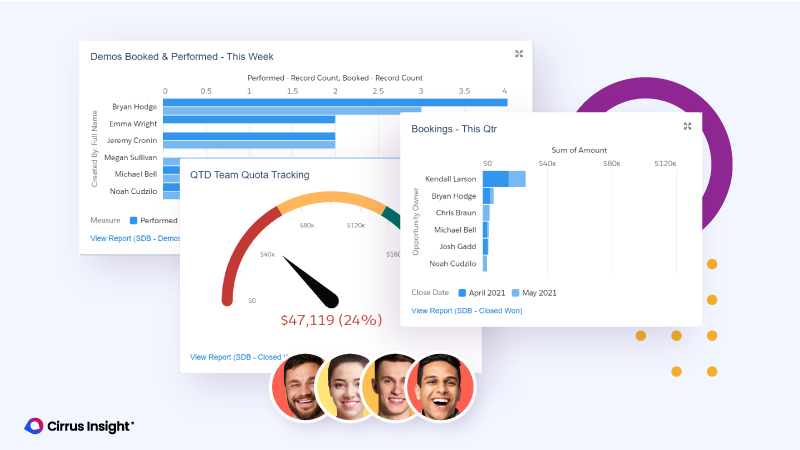
Sales Metrics vs Sales KPIs
Sales metrics and sales KPIs are often used interchangeably, but they serve distinct roles in evaluating sales performance. While both provide valuable insights, KPIs are more strategic, focusing on the most critical goals that drive business growth.
Sales Metrics: Broad Performance Indicators
Sales metrics are general data points that track various aspects of sales activities and performance. They provide insights into what’s happening in the sales process, but do not necessarily indicate success or failure. Examples include total number of calls made, email open rates, or average deal size.
Sales KPIs: Strategic Performance Drivers
Sales KPIs are specific, measurable goals tied to business success. They are the most critical sales metrics that indicate whether the team is achieving key objectives or not. KPIs typically align with revenue growth, efficiency, or customer retention. Examples include win rate, quota attainment percentage, and customer acquisition cost (CAC).
Sales Metrics vs. Sales KPIs: Key Differences
| Aspect | Sales Metrics | Sales KPIs |
|---|---|---|
| Definition | General performance indicators tracking sales activities | Targeted metrics tied to strategic business goals |
| Purpose | Provide insights into different sales processes | Measure progress toward key business objectives |
| Scope | Broad and includes various data points | Focused on the most critical success indicators |
| Examples | Number of calls made, email open rates, demo scheduled | Win rate, quota attainment, customer acquisition cost (CAC) |
| Impact on Strategy | Useful for tracking trends but may not directly impact decision-making | Directly influences strategic sales decisions and business growth |
Why the Distinction Matters
Understanding the difference between sales metrics and KPIs ensures that sales teams focus on the right data. While tracking a high volume of metrics can provide useful insights, prioritizing KPIs ensures that efforts are aligned with revenue goals and business success.
Core Sales Enablement KPIs to Track
1. Ramp Time for New Reps
A new hire doesn’t cost you money because of salary. They cost you money because they’re not productive yet.
What it measures: The time it takes for a new sales rep to reach full productivity.
Why it matters: Long ramp times delay revenue impact and increase onboarding costs.
Pro tip: Track ramp time by manager and onboarding program to see where coaching accelerates results.
2. CRM Data Completeness Rate
If your CRM is messy, your forecasts are fiction.
What it measures: The percentage of deals with complete, accurate, and up-to-date CRM fields.
Why it matters: Incomplete data leads to poor forecasting, misaligned coaching, and inaccurate KPI tracking.
Pro tip: Measure missing required fields at each stage to identify breakdown points.
3. Meeting-to-Opportunity Conversion Rate
Not every meeting should become a deal, but too many unqualified meetings signal a deeper problem.
What it measures: The percentage of booked meetings that convert into qualified opportunities.
Why it matters: This reveals how effective reps are at discovery, qualification, and positioning.
Pro tip: Break this KPI down by lead source to identify quality gaps.
4. Follow-Up Speed After Meetings
Momentum wins deals. Silence kills them.
What it measures: The average time between a meeting ending and a rep sending a follow-up email or next step.
Why it matters: Faster follow-ups dramatically increase engagement and conversion rates.
Pro tip: Track this KPI at the individual rep level; speed often correlates with close rate.
5. Content Utilization Rate
Creating sales content is easy. Getting reps to use it is hard.
What it measures: How often approved sales assets (decks, case studies, proposals) are actually used in conversations.
Why it matters: If content isn’t being used, it’s either hard to access or irrelevant.
Pro tip: Compare win rates between deals that used enablement content vs. those that didn’t.

The Best Ways to Track Sales KPIs
Tracking sales KPIs isn’t just about collecting data—it’s about using insights to improve performance, optimize workflows, and drive revenue. With Cirrus Insight, sales teams can seamlessly track, analyze, and act on key sales metrics within their existing workflow, ensuring every KPI is aligned with business goals.
Below, we break down how to track KPIs and highlight how Cirrus Insight’s features support data-driven sales success.
Guide to Tracking Sales KPIs with Cirrus Insight
Step 1: Define Your Sales KPIs
Start by identifying which KPIs matter most based on your company’s goals. Whether it’s win rate, sales cycle length, quota attainment, or lead response time, ensure your sales team knows what to track and why.
Step 2: Automate Sales Data Capture
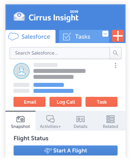
Accurate KPI tracking starts with clean data. Many sales teams struggle with incomplete CRM records due to manual data entry. Cirrus Insight automates data capture, logging emails, meetings, and customer interactions directly into Salesforce.
- Automatic email and calendar sync ensures no meeting or interaction is missed.
- Activity tracking provides a full timeline of buyer signals and customer engagement.
- AI-powered pre-meeting research helps ensure reps are always prepared to have high-value interactions that drive closed deals.
Step 3: Monitor Sales Activity in Real Time
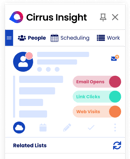
Tracking sales KPIs requires real-time insights to identify trends and adjust strategies. With Cirrus Insight, sales managers and reps can monitor buyer activity, pipeline progression, and customer engagement all from within their inbox or CRM.
- Live pipeline visibility tracks deals in progress and highlights bottlenecks.
- Buyer signals show which prospects are interacting with emails and attachments.
- Follow-up reminders ensure that no lead falls through the cracks.
Step 4: Optimize and Adjust Based on KPI Trends
Successful sales teams don’t just track KPIs—they continuously refine their strategies. With Cirrus Insight, managers can identify performance gaps and coach reps toward improvement
Measuring Sales Success Through KPIs with Cirrus Insight
Sales KPIs don’t drive growth on their own. Visibility does.
You can define the right sales metrics. You can build dashboards. But if your data is incomplete, delayed, or manually entered, your KPIs become assumptions instead of insights.
High-performing sales teams don’t just track KPIs, they automate them.
When activity, meetings, follow-ups, and buyer engagement are automatically captured inside Salesforce:
- Forecasts become more accurate
- Coaching becomes data-driven
- Pipeline gaps surface earlier
- Reps spend more time selling and less time updating CRM
That’s where Cirrus Insight fits in. It ensures your Salesforce data stays clean, complete, and actionable, so your sales KPIs reflect reality, not guesswork.
If you're ready to move from tracking metrics to driving predictable revenue, start a free 14-day trial or schedule a demo and see how automated visibility transforms performance.

Frequently Asked Questions (FAQs)
What are the most important sales KPIs to track?
The most important sales KPIs typically include win rate, sales cycle length, pipeline velocity, customer acquisition cost (CAC), customer lifetime value (CLV), and quota attainment. The right KPIs depend on your business model, growth stage, and revenue objectives.
How do you choose the right sales KPIs for your business?
To choose the right sales KPIs, align them with your revenue goals, sales strategy, and business model. SaaS companies often prioritize MRR, churn rate, and net revenue retention, while B2B sales teams may focus on sales pipeline KPIs like win rate and lead-to-opportunity conversion rate.
How do you calculate sales KPIs?
Sales KPIs are calculated using defined formulas based on CRM and revenue data. For example, Sales Conversion Rate = (Closed Deals ÷ Total Leads) × 100, and Customer Retention Rate = ((Customers at End − New Customers) ÷ Customers at Start) × 100. Accurate KPI calculation depends on clean, up-to-date sales data
What is the difference between sales metrics and sales KPIs?
Sales metrics track activities such as calls made or emails sent. Sales KPIs measure strategic outcomes like revenue growth, pipeline velocity, or customer retention. KPIs directly influence decision-making and long-term business performance.
What are sales pipeline KPIs?
Sales pipeline KPIs measure the health and predictability of future revenue. Common pipeline KPIs include pipeline coverage ratio, stage conversion rates, pipeline velocity, and average sales cycle length. These metrics help sales leaders forecast accurately and identify bottlenecks.
What are sales enablement KPIs?
Sales enablement KPIs measure how effectively tools, training, and processes support sales reps. Examples include ramp time for new reps, CRM data completeness, meeting-to-opportunity conversion rate, and follow-up speed. These KPIs focus on improving rep productivity and efficiency.
What are software sales KPIs?
Software sales KPIs are tailored for SaaS and subscription-based businesses. Key examples include Monthly Recurring Revenue (MRR), Net Revenue Retention (NRR), churn rate, and Customer Lifetime Value (CLV). These KPIs help track recurring revenue stability and long-term growth.
How often should sales KPIs be reviewed?
Sales KPIs should be reviewed weekly at the rep level and monthly or quarterly at the leadership level. Regular reviews help identify performance trends early and allow teams to adjust strategy before revenue is impacted.
What are leading indicators in sales?
Leading indicators are KPIs that predict future revenue performance. Examples include number of qualified leads, average response time, meeting-to-opportunity conversion rate, and pipeline growth rate. Tracking leading indicators helps teams act proactively rather than reactively.
Improve Conversion Rates
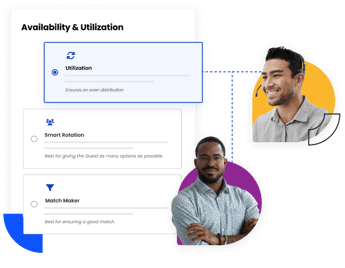
Test drive Smart Scheduler. Automatically route leads & avoid missed opportunities.